



Rome has a way of turning a two-week holiday into a five-year plan. What starts as a love affair with cobblestones and cacio e pepe often becomes a genuine question: could daily life here actually work, long term, for a solo traveller or a family?
The honest answer involves more paperwork than romance. Rome rewards those who understand its rhythms, its bureaucracy, and its neighbourhoods before committing. This guide walks through what moving to Rome actually costs, how rental contracts work, which visas apply to non-EU citizens, and when property ownership starts making more sense than renting.
None of this replaces professional advice. Tax residency and investment migration rules shift often enough that a specialist conversation is worth the fee before signing anything.
Key Takeaways
- Rome’s long-term cost of living hinges on neighbourhood choice, not just overall budget.
- Rental contracts in Italy follow specific legal formats that protect tenants who know the rules.
- Residency options for non-EU nationals range from elective residency to the 2026 digital nomad visa.
- Bureaucratic steps like the codice fiscale and permesso di soggiorno follow a predictable sequence.
- Healthcare, schooling, and tax residency each require practical decisions that long-term movers should make early.
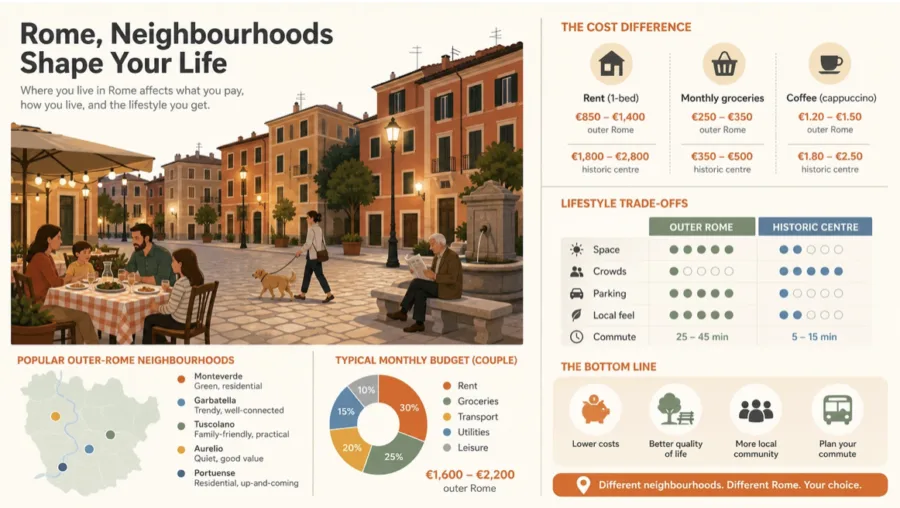
What Long-Term Life in Rome Actually Costs
The cost of living in Rome varies sharply by neighbourhood, and that variance shapes every other decision. Rent for a one-bedroom apartment near the historic centre runs well above equivalent space in outer districts.
Groceries at a neighbourhood market cost noticeably less than the same basket from a tourist-zone supermarket. Eating out at a local trattoria away from major piazzas remains reasonable for anyone on a moderate budget.
Public transportation, via the Metro and bus network, keeps daily movement affordable even without a car. Most long-term residents skip car ownership entirely, relying on transit and walking for daily life.
Utilities, mobile plans, and incidental costs add up gradually rather than all at once, which is why a full monthly budget matters more than any single rent figure.
Choosing a Neighbourhood for Daily Life
Trastevere draws newcomers with its lantern-lit streets and dense expat community, but that charm comes at a price and brings heavier tourist foot traffic. Monteverde, just up the hill, offers a quieter, more residential alternative popular with families settling in for good.
Testaccio blends working-class Roman character with a strong food culture and market scene, appealing to those seeking integration over insulation. Each neighbourhood asks a different question: proximity to landmarks, or the kind of daily life among Italians rather than fellow travellers?
Safety across these areas is generally solid, though pickpocketing near transit hubs and major sites warrants normal city-level caution. The right choice depends on whether culture and quiet matter more than convenience.
Rental Contracts: What Long-Term Tenants Need to Know
Italian rental law recognises two main formats. The standard 4+4 contract runs four years, renewable for another four, and gives tenants strong long-term protection.
A transitorio agreement covers shorter stays, typically for those with temporary work assignments or uncertain plans, running from one month up to eighteen. Landlords favour these when they expect to reclaim the apartment.
Whichever format applies, registration with the Agenzia delle Entrate and the local comune is mandatory, not optional. An unregistered lease leaves tenants without formal legal standing.
Ask landlords for proof of registration before signing. A security deposit, usually two to three months’ rent, is standard, as is confirmation that the property matches its listed use in comune housing records.
Those weighing residency routes tied to property or investment, rather than a simple lease, may find it useful to consult Global Residence Index, which advises on Italy’s residency-by-investment pathways for long-term movers exploring options beyond a standard rental or elective visa.
The Bureaucratic Basics: Codice Fiscale, Residency Registration, and ID
Before signing a lease or opening a bank account in Rome, every long-term mover needs a codice fiscale, Italy’s tax identification number. It is free and issued by the Agenzia delle Entrate, either at a local office or through an Italian consulate before arrival.
With that number secured, opening a bank account becomes straightforward, and most landlords and utility providers will ask for it before finalising paperwork. Many expats obtain it during their first week in the city.
Once settled, registration with the anagrafe, the local civil registry, establishes official residency. This requires proof of address, an ID document, and, for non-EU nationals, a valid residency permit.
Anagrafe registration also opens the door to applying for a carta d’identità, useful for daily transactions even though a passport remains the primary international travel document. The sequence rewards patience over speed.
Visas and Residency Permits for Long-Term Stays
Non-EU nationals planning long-term life in Rome need a visa suited to their income source and work situation, since Italy sorts applicants by how they support themselves rather than by nationality alone.
Elective Residency Visa
The elective residency visa suits those with substantial passive income, pensions, investments, or rental earnings, who intend to live in Italy without local employment. Consulates generally expect a single applicant to show roughly €31,000 to €32,000 annually, with higher thresholds for couples and families. Required documents include proof of stable passive income, a twelve-month lease or property deed, comprehensive health insurance, and a clean criminal record.
The Digital Nomad Visa
The digital nomad visa, fully operational by 2026, targets remote workers earning income from foreign employers or clients rather than passive sources. Applicants generally need at least six months of relevant remote-work experience, plus a degree or several years of professional experience.
Income minimums are tied to healthcare exemption thresholds; recent guidance for American applicants points to roughly €28,000 to €30,000 annually, though this figure moves with official thresholds.
Whichever visa applies, arrival in Italy triggers the next step: applying for a permesso di soggiorno within eight working days, converting the entry visa into a residency permit valid for the visa’s duration.
Understanding Italian Tax Residency as a Remote Worker or American Expat
Spending more than 183 days a year in Italy generally triggers tax residency, meaning worldwide income becomes reportable to Italian authorities rather than just Italian-source earnings.
Italy offers a flat-tax regime for certain new residents, alongside incentive schemes for qualifying incoming workers, which can reduce the taxable share of income for a limited period. Eligibility depends on employment type and prior residence abroad, so individual review matters.
For American expats, the US-Italy tax treaty helps prevent double taxation on pensions and retirement distributions, though US citizens still file federal returns regardless of residency abroad. Treaty provisions vary by income type, and professional guidance is strongly advised before relocating.
Healthcare in Rome: Enrolling in the System
Residents with a valid residency permit can register with the Servizio Sanitario Nazionale, Italy’s national health service, including many long-term visa holders once formally registered.
Enrollment happens through the local ASL office, Rome’s territorial health authority, and requires proof of residency, the codice fiscale, and permit documentation. Once registered, residents choose a family doctor, called a medico di famiglia, from a local list.
Those not yet eligible for the public system, or preferring faster specialist access, often carry private health insurance as a bridge, particularly during the early months before residency paperwork clears.
Schooling Options for Families Relocating Long-Term
Families moving to Rome long-term face a real choice between international schools and local Italian schools. International schools ease the transition, offering English-language instruction and familiar curricula for children arriving mid-year.
Local Italian schools, by contrast, accelerate integration and language acquisition. Children enrolled young often reach conversational Italian within a year, which supports daily life and friendships beyond the expat community.
The decision often hinges on the planned length of stay and how quickly parents expect to build fluency in Italian.
Property and Investment: When Renting Turns Into Buying
Renting remains the sensible first step for most newcomers, letting them test a neighbourhood before committing capital. Foreign buyers face no ownership restrictions, but should budget for notary fees, registration tax, and agency commissions in addition to the purchase price.
Mortgage access for non-residents is limited, so many buyers pay in cash or arrange financing before arriving. A local notaio (notary) verifies title and handles the legal transfer.
For those weighing property purchase against formal residency planning, it can help to consult the Global Residence Index before making any binding decisions.
Moving to Rome long term rewards patience: rent first, understand the market, then decide whether ownership fits the life you’re building there.