



A few weeks ago I received an email from a reader. Her name is Robyn; she is of Khmu heritage, and she had read my piece on trekking through the Khmu villages of northern Laos. She wrote about one photograph I took 16 years ago, an image in which a small child was bathing, genitals visible, and she asked, carefully and without accusation, whether I would crop or remove it, to protect the child’s privacy and dignity. Her tone was respectful, and her argument was reasoned. I cropped the image within the hour.
I want to write about why, because the answer is not as simple as “she was right, and I was wrong,” nor as self-justifying as “it is just how they live.” Two separate questions are tangled here, and I think most of the heat around images of childhood comes from refusing to pull them apart. One is about the scene. The other is about the file. They deserve different answers.
The scene
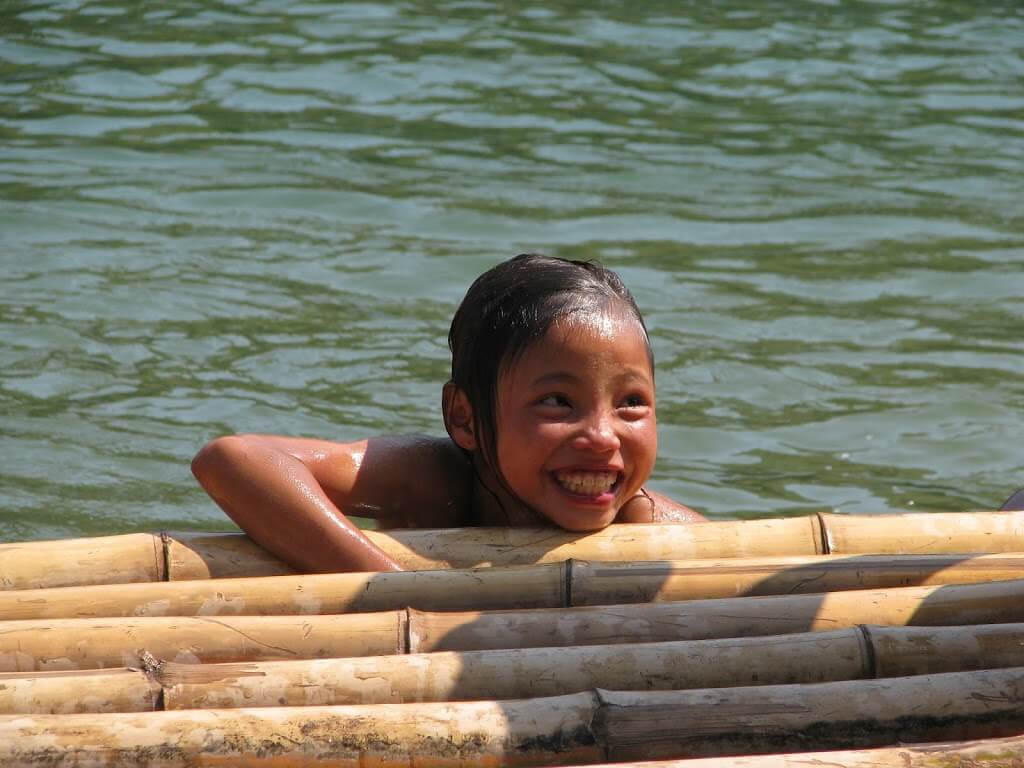
A child bathing without clothes in a river is not an event. In the villages I walked through, it is simply the afternoon. Children wash where there is water (as I used to do as a kid in Soviore, the monastery above Monterosso, in Cinque Terre); they run between houses without the careful layering we have been dressing our own children in in the last few decades, and nobody around them experiences this as exposure, because it is not. The nakedness carries no charge. It is daily life, lived close to the ground and close to the river, in a place that has not organised itself around the anxieties we have built.
The discomfort, when it arrives, is ours. We bring it with us. And I think it is worth being honest about where it comes from, because a reflex we never examine ends up governing a great deal. We have, for good and necessary reasons, become vigilant about the abuse of children. But vigilance has a shadow: suspicion applied before there is anything to suspect. And preventive suspicion does something strange to representation: it lets the worst imaginable viewer set the limit for everyone. The question stops being “what is happening in this picture,” which is a child having a wash, and becomes “what could the very worst person do with it,” which is a question you can ask of almost any image of a human being.
Follow that logic and childhood becomes progressively unrepresentable. First the bath goes, then the bare feet, then the child in a vest, then the face. And a second thing happens, quieter and in some ways worse. Cultures that live differently from us become showable only once we’ve cleaned them up to our standard. We will accept the village, but only dressed for our comfort. That is not respect. It is a last, soft form of telling other people that their ordinary life is acceptable to look at only after it has been corrected.
A first-person reportage exists to resist exactly that. It is supposed to show the place as it is, including its ease, its spontaneity and its distance from the distortions of what we call modern life, a life that looks more each year like the dystopias somebody imagined decades ago. I went to write what I saw. What I saw was, among many other things, a childhood lived without shame, and there was a real beauty in it that I don’t want to pretend I didn’t witness.
So on the scene itself, I have not changed my mind. There was nothing wrong in that river.
The file
And yet I cropped the photograph, and I would do it again, because Robyn’s actual point was not about the scene at all. It was about the file, and on that she is simply correct.
A published image is not a window onto a moment. It is an object that detaches from its moment and travels on its own. Once it is online and indexed, it no longer belongs to the article that framed it or to the intention that took it. It is copied, scraped, folded into datasets, and it can surface in contexts that neither the photographer nor the subject would ever have chosen. Everyone else in that chain had a say. The child did not. He could not consent to being photographed, cannot consent to being circulated, and will one day be an adult who had no voice in any of it.
That is not a cultural judgement. It is a judgement about a medium. The same child, in the same river, described in a sentence of prose, harms no one, because a sentence does not get scraped into a dataset and resurfaced stripped of its meaning. The problem was never the life. It was the distribution, and the fact that an identifiable image of a naked child is one of the few things that can be innocent at the source and genuinely dangerous in transit.
So the two answers do not contradict each other. I can hold that the scene was innocent and that our flinch says more about us than about the Khmu, while also holding that publishing an indexable photograph of that scene 16 years ago was the wrong call. The first is about a culture. The second is about the internet. Keeping them separate is the only way to be both honest about the place and protective of the person.
What I will carry forward
My rule from here is not complicated. I will keep writing these places truthfully, in words, including the parts that make a certain kind of reader uncomfortable, because sanitising other people’s ordinary lives is its own quiet disrespect. But I will not publish identifiable images of naked children, however innocent the moment, because I cannot control where the image goes once it leaves me, and the one person with the most at stake is the one who never got to decide.
I am grateful to Robyn for writing, and for writing the way she did, as an argument between people who both care rather than an accusation. She did not ask me to be ashamed of the village. She asked me to protect a child. Those are not the same request, and she was right to make the second one.







One Comment