



Some winters ago, in December, I had one of the most incredible experiences of my life: a husky safari deep in the Finnish Lapland wilderness. A week driving my own team of dogs from cabin to remote cabin, across frozen lakes and through snow-laden forest, with no electricity, no running water, and no way out but forward.
I had been putting it off for years. The pandemic settled it: we have one life, we are already living it, and the things we dream about should stop being “one day”. So I opened my browser, found the best husky safari I could afford in Europe, and booked it.
I had fallen for Finnish Lapland twenty years earlier, on a summer horse-riding trip through the forests around Kuusamo during the White Nights, and I had longed to come back in winter, to live in real-life Narnia for more than the quick aurora getaways I had managed in between. This is how it went, honestly, including the parts that were hard and the questions worth asking before you book one yourself.

My husky safari in Finnish Lapland
I booked a one-week safari starting near Muonio, close to the Swedish border, with Harriniva, whose trip promised seven days driving my own dog team through north-western Lapland, cabin to remote cabin, across snowy forests and frozen lakes in an area with some of the cleanest air in Europe. I expected adventure and, from my horseback experience, a fair amount of daily camp work. I did not quite expect how physical it would be.
I flew into Kittilä, took a pre-arranged transfer to a wilderness hotel near Muonio, had a wonderful salmon dinner in a tipi-style cabin, and played in the snow like a child. After the pandemic, I had missed snow more than I can say.
The next morning moved fast. A dawn wake-up, a quick breakfast, and the collection of the Arctic kit the trip provides: boots, heavy wool socks, over-trousers, jacket, mittens, balaclava, trapper hat and a sleeping bag. Then I met the six other slightly crazy people I would spend the week with, and our guide. We talked briefly, and headed to the kennels.
The first hour was overwhelming; I will be honest. The kennel had not been cleaned yet, hundreds of dogs were bouncing and barking, and harnesses, ropes and cables lay piled everywhere. Our guide showed us how to harness the dogs and clip them onto the line, we practised on her team, and then she introduced each of us to our own dogs, and that was when it landed that I would be alone on my sledge for the whole week. I had done a single day of mushing before, in Abisko, but not alone, and I felt a flicker of panic.
Once my team was harnessed- and trust me, at minus twenty, in thick gloves, fitting harnesses onto newly met and wildly excited dogs while handling frozen cables and snap-hooks is no small task- our guide gave us perhaps three minutes of instruction on how to stand, how to brake, and how to read her arm signals. And then we were off.
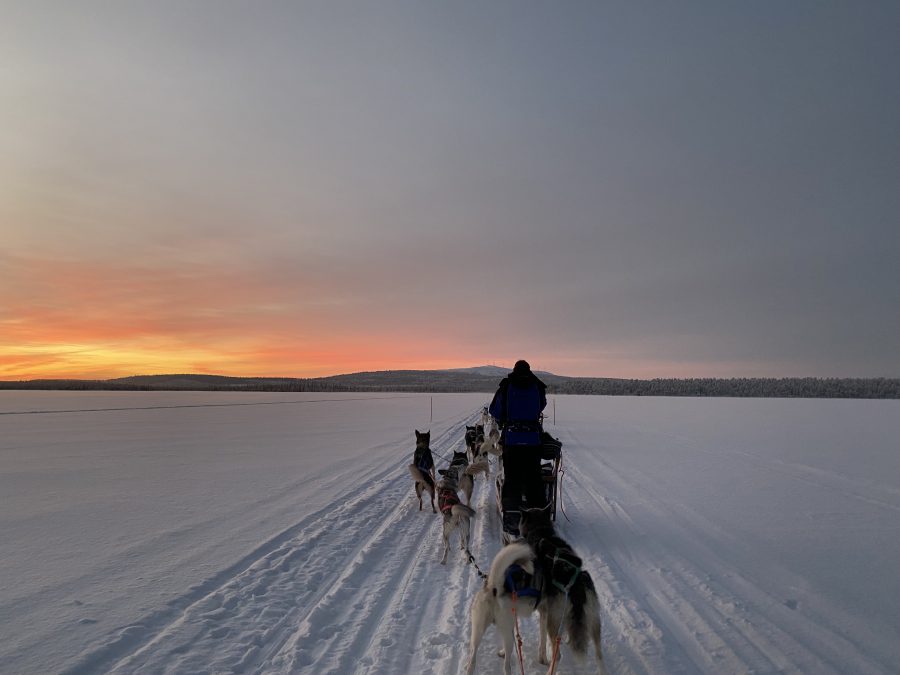
For the first few minutes I could not think, trying at once to balance, watch my lead dog, the guide, the slopes and the trees. Then the silence, the white, and the sheer magic of it made me smile. From adrenaline to peace in seconds, over and over, all week. The only sounds were the dogs’ paws on the snow and the runners hissing over it. Heading away from the farm into the wild is something I will never forget.
We drove around five hours a day, thirty to forty kilometres, and stayed in simple, charming cabins, responsible the whole time for our own team: preparing their food (frozen reindeer meat to gnaw by day, boiled in the evening), settling them at night, and cleaning their area before we moved on. Our guide cooked for us, lunches over open fires in the wild, full meals at night, while we dug holes in the ice to draw water for the sauna and the cabin, lit the fires, and in the morning cleaned the cabin and chopped and restacked wood for the travellers who would come after us. That last detail, restocking the wood for strangers, tells you something lovely about how this world works.
It is a unique kind of beauty: a pristine winter wilderness of snowy forest, frozen lake and tiny fairytale cabin, shared with adventurous people happy to muck in, and with clever, cheerful, strong, funny dogs you come to love fast. Pure magic.



The dogs: welfare, and the questions to ask
Before I booked, my single biggest worry was the dogs: their treatment, their lives, what becomes of them. I think that worry is the right instinct, and I want to give it proper space here, because it matters more than any other part of planning a trip like this.
I asked a great many questions before confirming, and I was reassured that the dogs were genuinely loved and well cared for. Huskies are bred to run and pull; they are built for it and visibly happy doing it, and they are far more comfortable in the cold than in a warm house, content at minus fifteen and hot above freezing, which you understand the moment you spend real time with them. My own team of five, led by wise, over-furry old Wind and brave skinny Gaga, with shy young Mojito, sturdy Xylitol and my crazy sixteen-month-old baby Outa on his first overnight safari, were magnificent, and their joy was infectious. Cuddling them at lunch, playing with them in the morning, was the highlight of the week. When we returned them to the kennel on the last day, I cried.


But not every operation is the same, and the standards you cannot see matter as much as the ones you can. So, wherever in the world you are thinking of doing this, research the welfare of the dogs before you book, and if the answers are not clearly published, ask directly:
- How are the dogs housed, and how much space and social contact do they have off-season?
- How are they trained, and what happens if a dog does not take to sledding?
- What happens to them when they retire, and how long do they stay with the operation?
- What is the vet care, and the ratio of dogs to handlers?
A good operator will answer these gladly and in detail. Vagueness or defensiveness is your answer. This is the single most important thing I can tell you about husky safaris, and choosing well is also how you push the whole industry towards treating these animals as they deserve.
A little history
The word safari comes from the Arabic safara, to travel, so a “husky safari” is, quite simply, a journey by dog.
Travelling by sledge dog is ancient: Arctic and sub-Arctic peoples, including Inuit, Sámi, and Siberian communities, have relied on dog teams for transport and survival for thousands of years. What is recent is the commercial husky farm built for visitors, which grew up alongside polar exploration in the late nineteenth century, the sledge-dog racing that followed, and, in recent decades, tourism. It is worth holding both truths: the practice is deeply old and indigenous, while the week-long safari you can book online is a modern, commercial layer on top of it. That is part of why asking how a given operation treats its dogs and its heritage matters.
A husky safari is not for everybody
And here is the honest warning, because this is not the glossy version.
A husky safari is physically exhausting, and you never really rest or get time to yourself. Living without electricity or running water in deep winter is genuinely hard. Pulling on heavy layers and boots to reach a half-frozen wilderness toilet by head torch is not always funny. Showering in a shared sauna, mixing freezing and boiling water in plastic buckets, is either hilarious or maddening depending on your mood. Falling asleep next to, or above, a snoring stranger you met that morning is its own endurance test.
It is not for you if the elements frighten you: deep snow and biting wind are normal, temperatures drop to between minus twenty and minus thirty, and you can never predict which trails will be open, in what state, or how far the dogs can run on a given day. And it is emphatically not for you if your priority is perfect photos for Instagram, or looking good in them.
Was it for me? Absolutely. I loved it, and I even loved the parts I hated, and I sincerely hope to do it again one day, perhaps in Alaska. If you recognise yourself in that, go. Just go with your eyes open, and choose your dogs’ people carefully.
Further reading
- Finnish Lapland on horseback, the summer twin of this trip
- A complete guide to the Finnish sauna, which saved my muscles here too
- Finland, one of the best countries for expats
- How I plan trips like this, alone and independently: independent travel
- My trips in The North
FAQ
A husky safari is a multi-day trip in which you drive your own team of sled dogs through the winter wilderness, travelling from cabin to cabin and helping care for the dogs and camp along the way. Trips range from a single day to a week or more, typically covering 25 to 40 kilometres a day, and are physically demanding, since you help feed and settle the dogs and run the cabin.
No. Sled dogs are highly trained and know the commands, so beginners can learn quickly, and the operator gives you basic instruction before you set off. You should be reasonably fit and steady on your feet, as you stand on the sled and help brake and steer, and you may fall once or twice on the first day, but the common guidance is that if you can ski, you can learn to mush.
They can be, with a responsible operator, but standards vary, so it is worth researching welfare before booking. Look for clear information on how the dogs are housed, trained and cared for, the dog-to-handler ratio, and crucially what happens to the dogs when they retire. A good operator answers these questions openly; vagueness is a warning sign. Choosing carefully also encourages the whole industry towards higher standards.
Roughly December to April, when there is reliable snow. Midwinter brings the deepest cold and the polar night with strong aurora chances but very short daylight, while late winter and early spring offer more light and slightly milder temperatures. Conditions are always weather-dependent, and temperatures commonly fall to between minus twenty and minus thirty.
No, and it helps to be honest about that. It is physically exhausting, often without electricity or running water, in extreme cold, with little privacy or rest. It suits people who genuinely want adventure and can embrace discomfort, and is not for those who need comfort, predictability, or perfect conditions for photographs. For the right person, it is unforgettable.



One Comment