
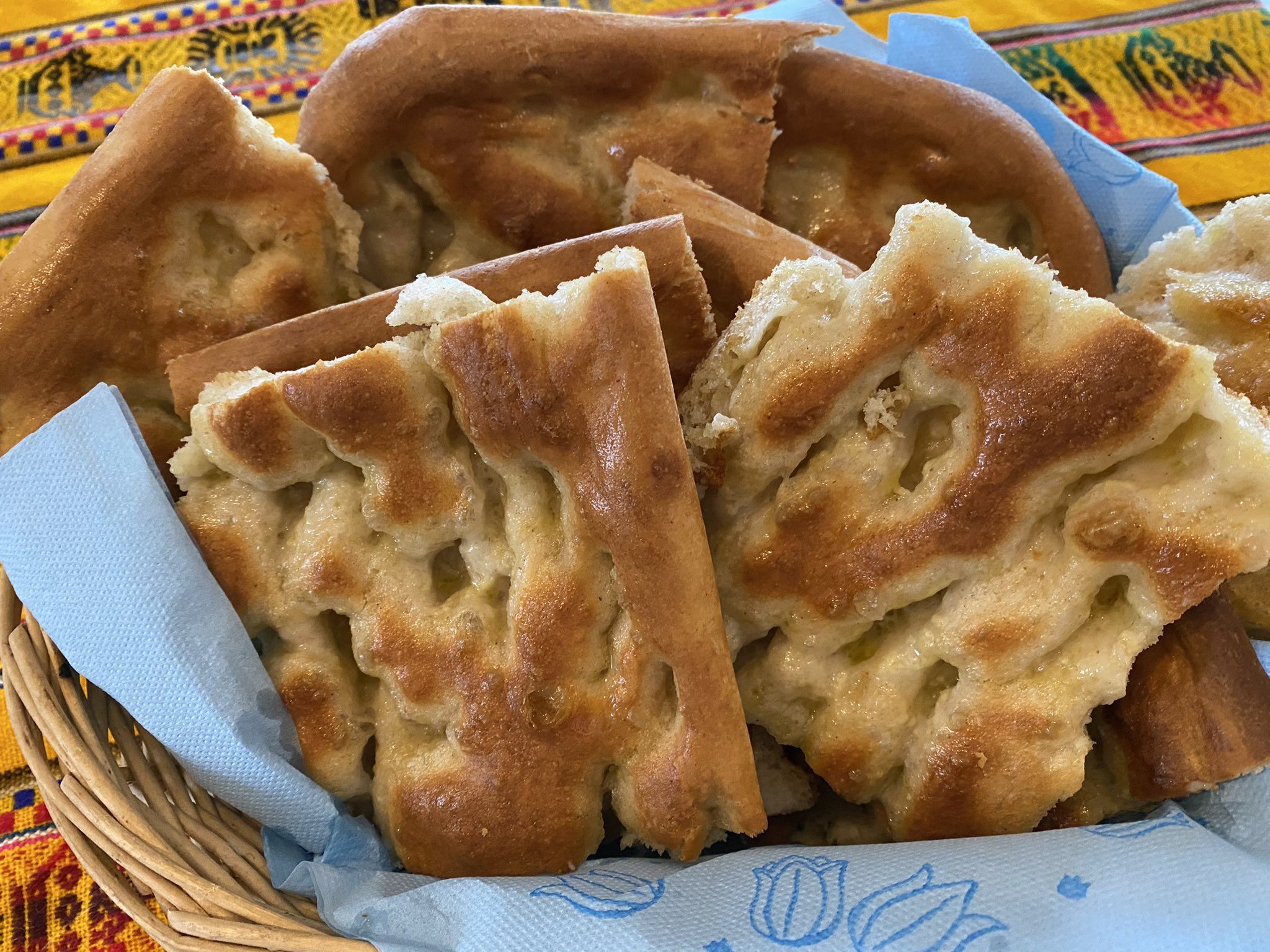

I practically never eat bread, but the Genoese focaccia is an entirely different story, and I can’t resist it, no matter what time of day it is!
Fugassa, in Genoese, means baked. In the Middle Ages, it was customary to eat it in the church during weddings to wish the newly married couple prosperity. Today, it is one of the symbols of Genoese cuisine, and its recipe is protected by the Focaccia Genovese brand (Collective Brand GE 1996 N ° 0001187822).
On the Italian Riviera, we eat it for breakfast, dipped in our morning coffee or cappuccino, but it is also delicious stuffed with sliced cold meats or cheese, for a mid-morning snack, as an aperitif, or during meals.

Its story
As mentioned, it was even consumed during the sacraments in medieval times and up to the Renaissance, but it was a dish already known by Phoenicians and Romans, who did not use yeast.
In the seventeenth century, Genoese focaccia became a famous street food, produced and sold in the sciamadde, the ancient fried food shops that arose as salt resale shops, of which Genoa had a monopoly. These shops were equipped with ovens to bake cakes, pies, and focaccia.
Today, Genoese focaccia can also be bought at bakeries. In recent decades, countless focaccia shops with almost unlimited offers have sprung up: focaccia with olives or sage (my favourite!), rosemary, potatoes, tomatoes, or cheese. The most popular, however, remains the focaccia with onions, which is very widespread among harbour workers because it can block the hunger stimulus, satiating very quickly and for longer.
You can order and pay for it by weight, but the Genoese unit of measurement is the sleppa or slerfa, corresponding to 1⁄8 of a dripping pan (about 150-200 g).
The Genoese focaccia recipe
One of the only positive aspects of the first lockdown was the possibility of perfecting my homemade Genoese focaccia. I have had time to try it again and improve.
Sure, I put on about ten kilos, but now my focaccia is soft but not chewy on the inside, crunchy and golden at the edges and on the surface. Perfect.
The ingredients
- 340 g of whole wheat flour W290
- 200 g of warm water
- 7 g of salt (dissolved in the recipe water)
- 5 g of malt (used to feed the yeast. If you don’t have any, you can use a teaspoon of sugar or honey)
- 8 g of brewer’s yeast (best dissolved in a little unsalted water from the recipe)
- 15 g of extra virgin olive oil
- 25 g of extra virgin olive oil to grease the pan
- 2 tablespoons of extra virgin olive oil to brush the focaccia once cooked


The dough and the various steps
- Put 90 g of flour, 40 g of salted water and 1 g of yeast in a bowl. Knead for five minutes and let it rest for at least 12 hours (I start the night before and let it rest at room temperature for the whole night);
- Once rested, add the rest of the flour and the malt and while mixing, little by little, 90% of the salted water. Then add the rest of the crumbled brewer’s yeast and, once incorporated, the oil, constantly stirring;
- Add the remaining water once the oil is incorporated and continue kneading for at least 5 minutes. The dough is perfect when it is very elastic and difficult to tear;
- Pour the dough on the work surface and fold it to form a slightly flattened rectangle, with the fold facing down, and let it rest for 30 minutes, covered with cling film and a dish cloth;
- After 30 minutes, grease a rectangular pan (30 cm x 40 cm), roll out the dough, taking care to keep the same shape, until it covers about 70% of the dripping pan and let it rest again for half an hour under the cling film;
- Now you can roll out the dough to cover the entire surface of the pan, taking care to eliminate any air bubbles; cover with cling film and leave to rise for another 60 minutes;
- Sprinkle generously with flour and make the famous holes * using the phalanges of both hands, then cover them with the brine, prepared by mixing 20 g of olive oil and 5 g of warm salted water (5 g of salt per 100 cm of water ) and let it rest for another 60 minutes, always under the film;
Preheat the oven to 230 ° C and bake for 15 minutes. Always pay attention to the cooking because the focaccia will be ready as soon as the surface is golden.
Once out of the oven, turn it upside down and brush the bottom and crust with extra virgin olive oil. Then, leave it to cool, possibly on a wire rack to keep it crisp on the outside.
* The holes should be close together and as parallel as possible to the surface, and considerable pressure should be applied with the fingertips.


Enjoy it!
P.S. The so called focaccia di Recco, with cheese, it is not a variant of the Genoese focaccia. The dough is not leavened, and the cheese fills two very thin layers. A delight!