

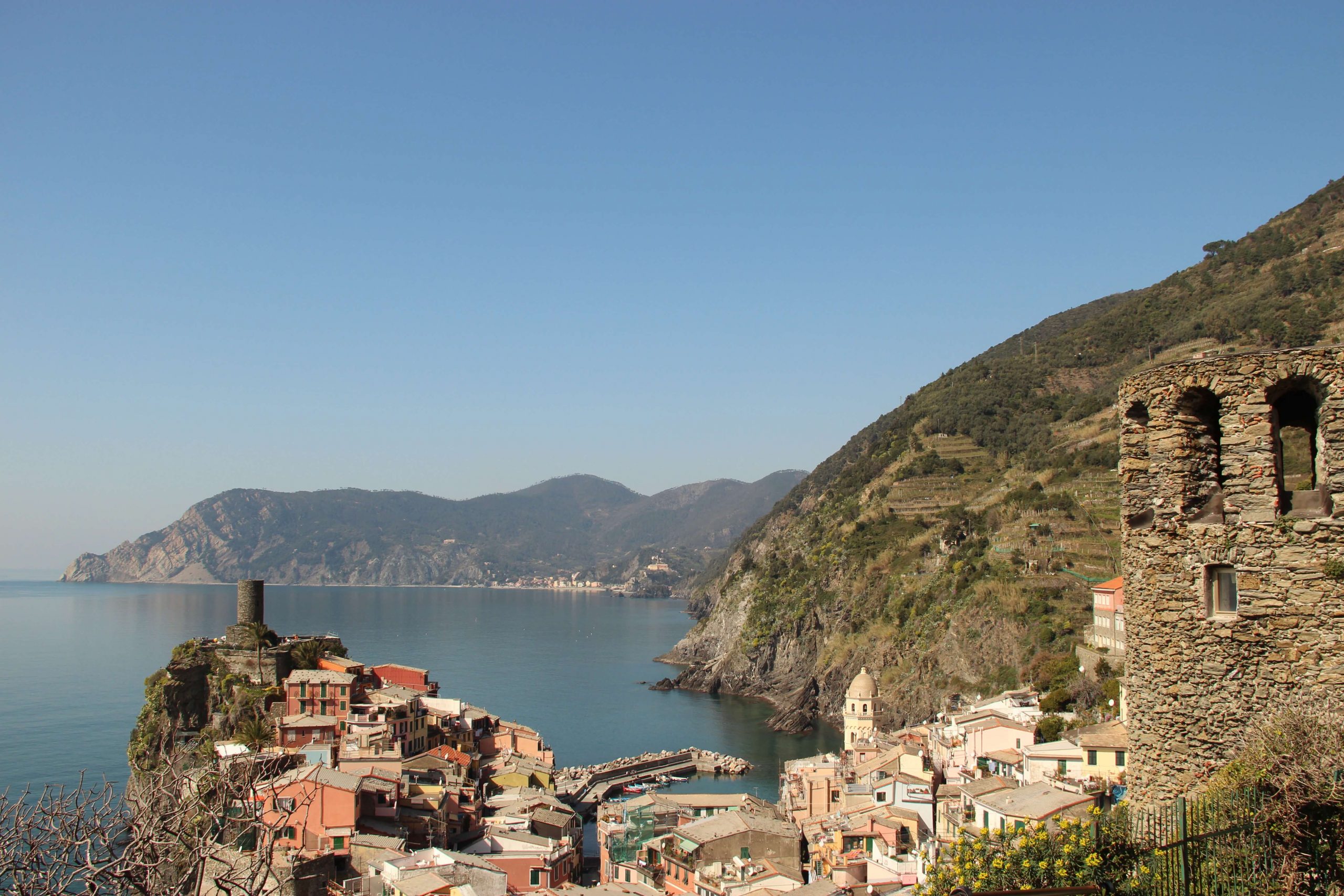

I grew up in Vernazza, and I know exactly how lucky that makes me.
It is a village of around five hundred people, no cars, one natural harbour, and a beauty so photogenic that the world has arrived to collect it. Rick Steves found us first, then Lonely Planet, then everyone, and now the five villages are on every bucket list there is.
We are proud of that, mostly. It is also true that these places are very small and fill up very quickly.
So I want to offer you a different way in. Not the postcard route, and not a checklist. Vernazza, as I actually carry it: a map made of smells.
Because here is the thing I have come to believe, and it took me years to put into words. A fragrance is the one thing you can take away without taking anything at all. You cannot photograph it, queue for it, or tick it off a list. You have to be here, and slow, and paying attention. Which is, I think, the only honest way to visit anywhere.

First, a little about the place
Vernazza was cut off from the world for most of its history and only became easy to reach when the railway came. No cars come in except on Tuesday morning for the weekly street market, which doubles as the village’s social event.
It has the only natural harbour in the Cinque Terre. Until the days of the Republic of Genoa, there was neither beach nor square: the sea came right up to the buildings of what is now Via Roma, and boats tied up against the houses. A small, salty Venice. The Latin name of Vernazza, fittingly, was Vulnetia.
Above it all stands the Doria Castle, the Castê, built around the eleventh century to defend the village. Its perimeter is completely irregular, because the walls simply follow the cliff. If you want to understand that at a glance, walk in from Corniglia and look down from the watchtower on the path. It is the finest arrival in the Cinque Terre and worth arranging your day around.
Down on the water sits the church of Santa Margherita d’Antiochia, with its strange entrance on the altar side and a view straight out to sea.
The map of scents
Ventegà, and the smell of salt
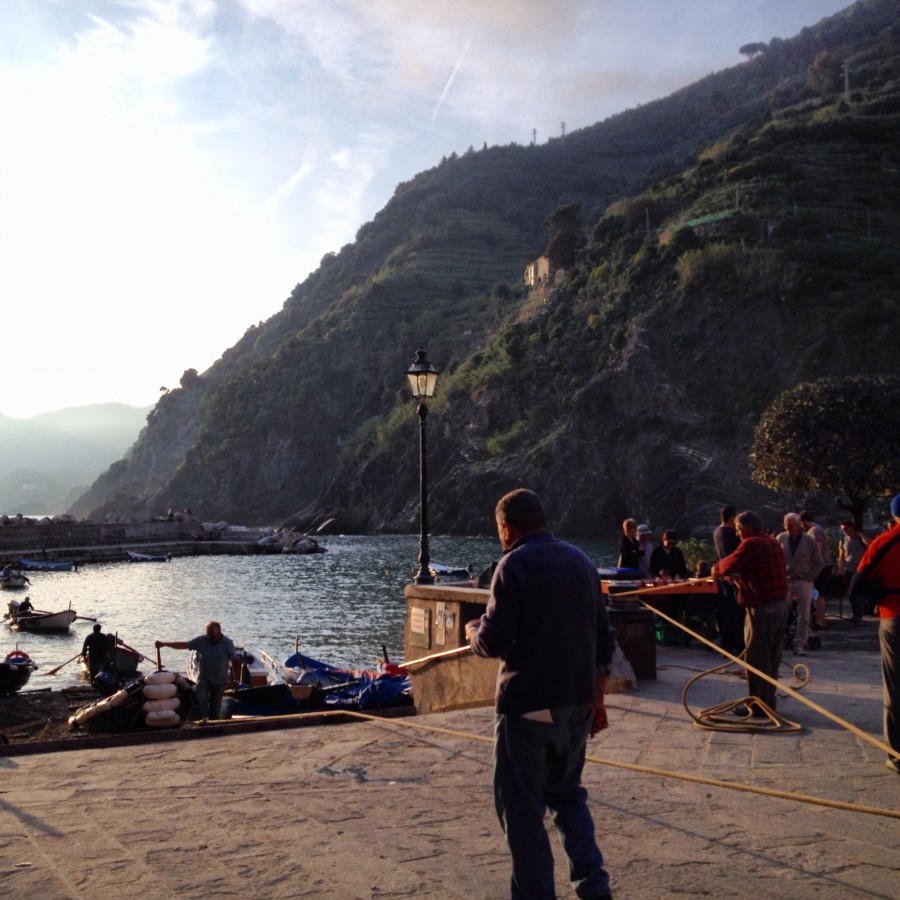
Brackish salt takes me instantly to Ventegà, wherever in the world I happen to be standing when I smell it. Ventegà is the little square beneath the old Belforte bastion. In summer, the tourist ferries dock here, and the village children learn to dive from a rock called Gaggiaèlla. In Vernazza, even the rocks have names.
Out of season, that corner is silence and magic. If you meet anyone at all, it will be a solitary fisherman or a cat looking to be adored. The salt is more concentrated there than anywhere else in the village, and it is the best place I know to let your thoughts go loose.
The gozzi, and the smell of a storm coming
There is a second kind of salt smell, the one that rises off the gozzi, our brightly painted wooden boats, when they are hauled up and turned over in the village.
Normally, they sit out on their moorings. They come ashore in winter for their annual maintenance, and they come ashore when the red flag goes up for heavy seas, especially with a south-westerly, when the salt swallows the whole village. Then the main square, which usually belongs to the restaurant parasols, fills with upturned boats, all the way up the right-hand side of Via Roma.
That right-hand side is the shaded one, and we call it Lùvegu, which in the Vernazza dialect means dank. Facing it is the sunny, flowering side: Sciuiu. Two words for two halves of one street, which tells you something about how closely a small place watches itself.
Lùvegu, and old stone
Lùvegu is not exactly a perfume, but it has a particular version that comes off very old, very thick walls, and you meet it inside both the harbour church and the castle. It smells of cold stone and centuries, and I find it oddly comforting.

The caruggi, and the babel
In the narrow alleys, the caruggi, everything mixes.
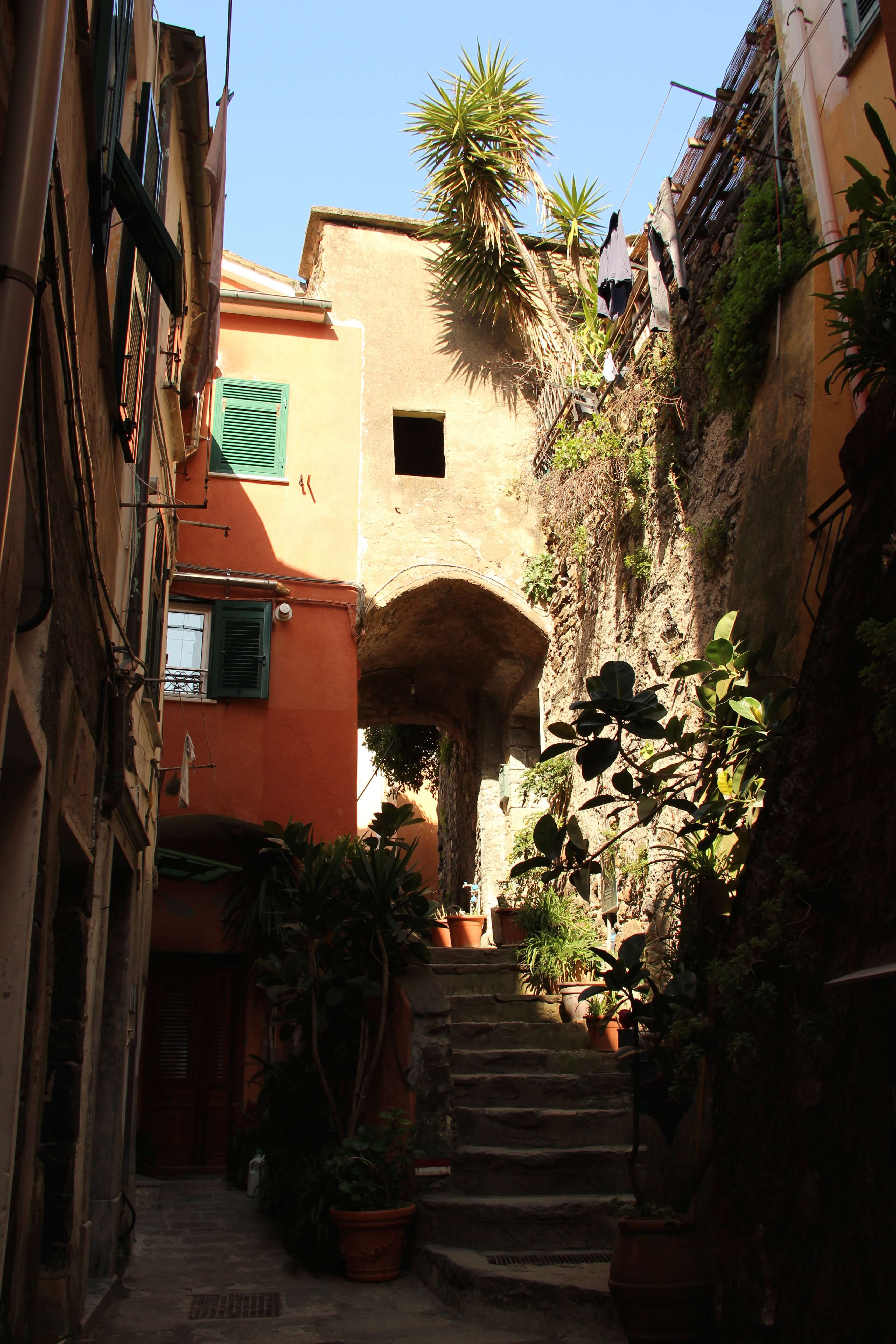
Washing strung from one house to the other, a rainbow of flapping laundry. Private cellars. The sharp brine of fresh anchovies is packed into arbanelle; the glass jars are weighted with flat, round stones to press them as they salt. Oregano lay out to dry on kitchen windowsills. It is a babel of smells, and it is the true perfume of this village.
The vinegar alley, which I never smelled
And then there is one I have never smelled, and have spent my life imagining.
What is now Via del Santo, on your right as you come down the station steps, used to be called Caruggiu dell’axéu: vinegar alley. Nobody had running water in their cellars, so people waited for rainy days to wash out the demijohns and casks that held the wine. The dregs ran out of the doorways and down the stone, and the whole alley smelled of it.
I would like to have walked down that street once, on a wet afternoon, a hundred years ago.
The other Vernazza, the one facing inland
The Cinque Terre is not only the sea, and this is the part that visitors almost always miss.
Turn your back on the harbour, and there is an old, hard, agricultural place up there, and it is where I keep most of my childhood. Every morning I went out with my grandfather, absurdly proud to be allowed, and spent hours watching him dig furrows, plant, water. Being handed an actual job was the greatest honour available.
His allotments were scattered all over the village. These are the ones I loved best.
The one above the deconsecrated church of the Fratti, the Reformed Friars Minor of Saint Francis, now the town hall, beside the remains of the old walls. I loved it because from there I could see our house up in Fontanavecchia, the old fountain quarter, and because I could eat peaches, apricots, pears and kumquats straight off the trees. In high summer, blackberries. If you pass, stop for the view from the church, then climb one level higher to the cemetery, which has the better one.
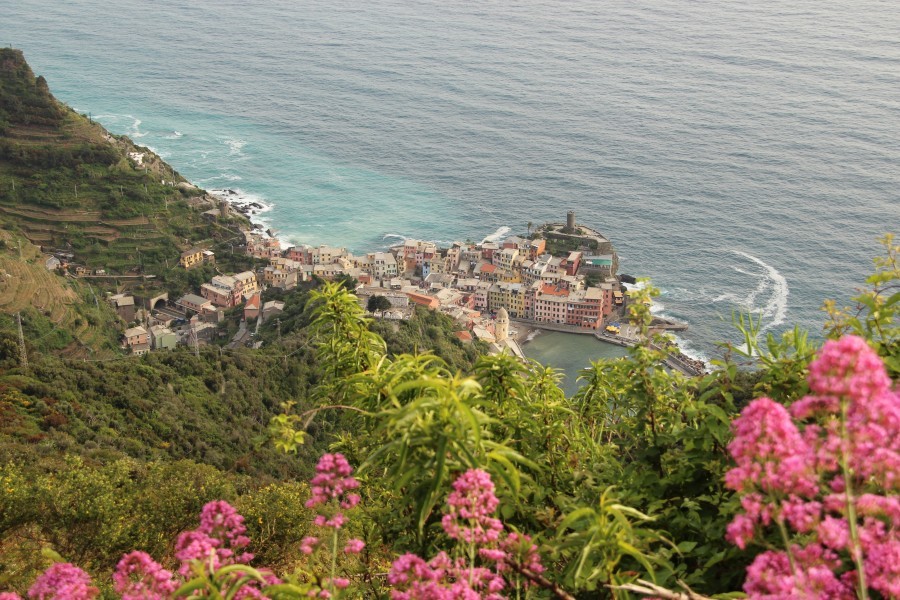
The one below the Shrine of Reggio. You reach it through vineyards, olive groves and ciàn, the little private gardens, and it is dear to every single person in this village. On the first Sunday of August, we celebrate Our Lady of Reggio: a procession up to the sanctuary the day before, with the children dressed as pilgrims, which was my own personal tragedy and my grandmother’s delight, and then on the Sunday, we all eat together in the yard and finish with a glass of Sciacchetrà, our famous sweet wine. If you come to Vernazza, walk up to Reggio. You can also cycle it, which I did not long ago and loved.
The one on the path towards Monterosso, which happens to be the olive grove that everybody now stands in to take the classic photograph of Vernazza. I find that funny, a little sad, and entirely understandable.
And one that no longer exists. It was taken by the flood.
The flood
On 25 October 2011, within hours, a catastrophic flood and mudslide buried Vernazza under four metres of mud and debris. The water reached second-floor windows. Road and rail were cut. We were left without water, gas or electricity. Homes and businesses were destroyed. Three people drowned.
I have written about that day separately, because it needs its own space, and I will not compress it here.
What I will say is this. When you walk through Vernazza now and find it beautiful, you are looking at something that was dug back out by hand, by people who live here and by strangers who came to help. That is worth knowing while you take your photograph.

The cellar, and the vines
One more smell, rarer now: the cellar. Wood, must, wine. Everything around the harvest was a celebration when I was small, days of family and friends, shared work, and a great deal of laughing despite aching backs.
Very few working vineyards are left in Vernazza. If you want to see one and understand what it costs to farm a cliff, go to Bartolo Lercari’s, which he runs with his wife, Lise and a dog called Diva. In my view, he deserves a monument.
If you are coming
A little practical honesty from someone who lives here.
Come out of season. Vernazza in October, in March, on a wet Tuesday in February, is the village I have been describing. Vernazza in August at midday is a queue. The place doesn’t get less beautiful, but it becomes impossible to feel. If you can only come in summer, come early in the morning or after five, when the day-trippers thin out and the light softens, and the village exhales. And if you are wondering why a village this small feels so stretched in high season, I have written about what overtourism really does to a place like this, and how to tread more lightly.
Arrive on foot from Corniglia if you can manage it. The view as you come round to the castle is the reason people fall in love with this place, and you cannot get it from the station.
Check the trails before you set out. Closures here change with weather, maintenance and landslides. Wear proper shoes, not sandals, which are in fact banned on the paths and carry a fine. Carry water.
Remember that people live here. Five hundred of them. The elderly women you are photographing on the benches are trying to sit down. The terraces and trails you are walking were not built for you; they were built by our great-grandparents to reach olive trees and vines, and they are held up by dry-stone walls that somebody still has to maintain. I write about why all of this matters, at greater length, here. I’ve also written about this in my piece on tourism sustainability, if you want to understand why Cinque Terre was never built for mass tourism.
And then take the smell with you
That is my Vernazza, and I carry it everywhere.
Because the beauty of a fragrance is exactly that you can take it away with you without taking anything at all from the plant, or the place, or the person it came from.
I cannot think of a better way to describe how I would like people to visit.
Further reading
- My guide to the 12 most beautiful beaches on the Italian Riviera
- What I think about tourism, sustainability and the crowds
- Loving a place without loving it to death
- Cinque Terre National Park, for trail status and the Cinque Terre Card
- About Vernazza’s flood.
FAQ
Vernazza has the only natural harbour in the Cinque Terre, and it is the only one with a castle: the eleventh-century Doria castle, whose irregular walls follow the shape of the cliff. It is a village of around five hundred people, closed to cars, and widely considered the most beautiful of the five.
On foot from Corniglia. The coastal trail brings you round to a view of the village and its castle from above, which is the finest arrival in the Cinque Terre and is impossible to get to from the railway station. Check trail status before setting out, as closures are common.
Out of season, if you can: October, March, or even a wet February day, when the village belongs to itself again. If you must come in summer, arrive early in the morning or after five in the afternoon, when the day-trippers thin out and the village becomes liveable again.
On 25 October 2011, a catastrophic flood and mudslide buried Vernazza under around four metres of mud and debris. Floodwater reached second-floor windows, road and rail links were severed, and the village was left without water, gas or electricity. Three people drowned. The village was dug out and rebuilt largely by hand.
No. Flip-flops, sandals and smooth-soled shoes are banned on the Cinque Terre National Park trails and carry a fine. The paths are steep, rocky and closer to mountain trails than seaside walks, so proper trainers with grip are a minimum, and hiking shoes are better.





Vernazza is my favourite of the 5 villages. I am pleased that it seems to have recovered from the devastation a few years ago. It is time to revisit these lovely towns.
Hello Debra,
Yes, there’s still a lot to do, but things are getting better and Vernazza is beautiful as always 🙂