

There are many ways to “taste” Liguria. You can sit at a restaurant table and order trofie al pesto, of course. But if you want to understand why pesto is not just a sauce here, but a small ritual, a family pride, and a very precise balance of ingredients, then you need to make it yourself. Slowly. With a mortar. The proper way.
That is exactly why I host a pesto cooking class in Levanto at my Oasi Eco Boutique Hotel, a simple, hands-on experience designed for travellers who love local food, want to learn something practical, and are curious about Ligurian traditions beyond the postcard clichés.
This is not a show cooking event. It is a real class, with real technique, real mistakes, and real satisfaction when you finally get that bright green, fragrant pesto that tastes like Liguria in a spoon.

Where and when the experience takes place
If you’re coming to Liguria, there’s one experience that always feels like a shortcut into local life: making pesto the old way, with a mortar and pestle, at a table where people chat, laugh, taste, and leave with green fingers and a little pride.
The class is held at Oasi Eco Boutique Hotel in Levanto, at the gateway to the Cinque Terre.
- Season: April to November
- Days: Thursday to Monday
- Time: 12:30
- Location: Oasi Eco Boutique Hotel, Levanto, Liguria
- To book: https://www.airbnb.it/experiences/242115
It is a perfect midday plan, especially if you want to spend the morning at the beach or exploring the village, then dedicate lunch time to something memorable and delicious.
A delicious plot twist: the “original” pesto had no pine nuts
You know the pine nut, right? The one you put first in the mortar. The one that costs a small fortune at the supermarket. The one that many people treat as proof that a pesto is “real”.
Well, the first written pesto recipe in history, in 1863, had not a single pine nut.
Not metaphorically. Literally.
In Genoa, 1863, Giovanni Battista Ratto publishes La Cuciniera Genovese, one of the earliest texts to codify Ligurian cooking. When he writes down pesto, his ingredient list is:
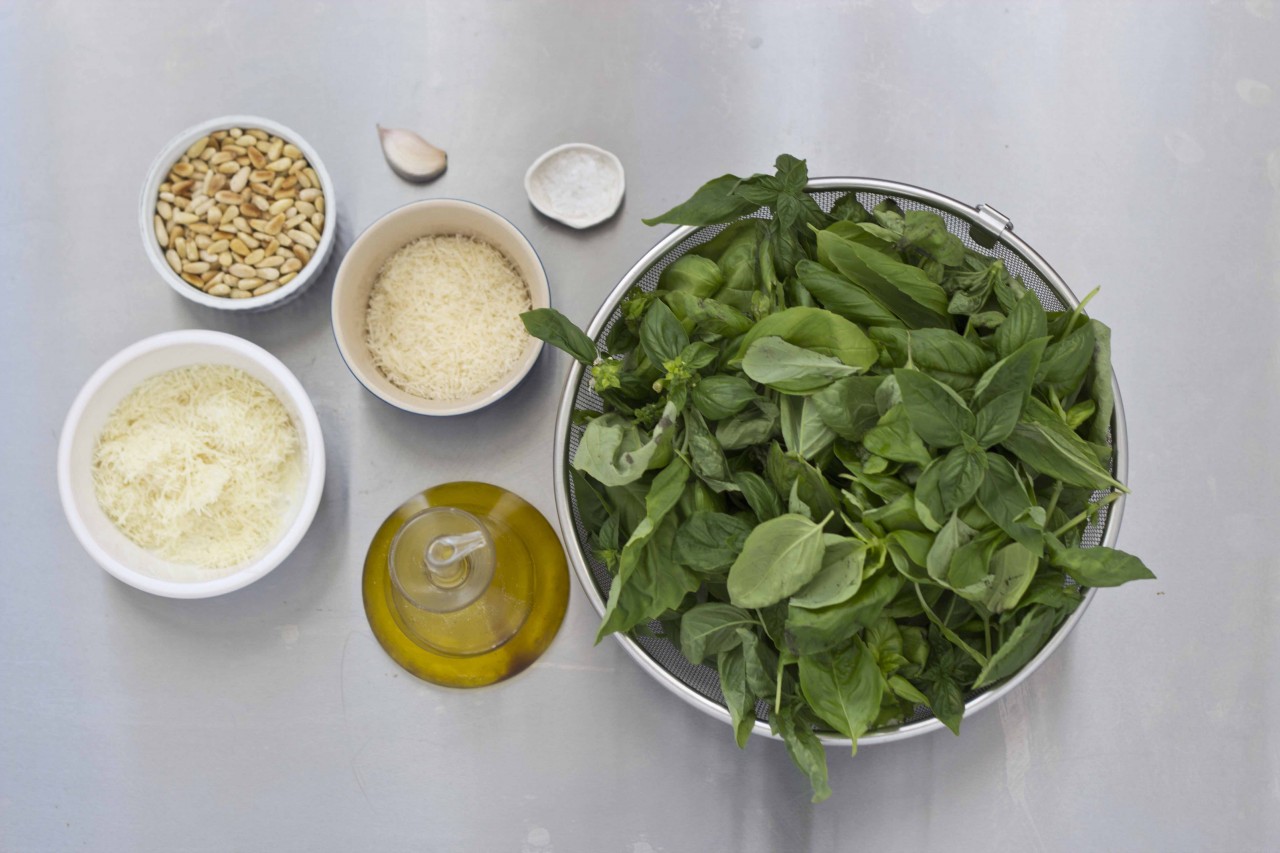
- garlic
- fresh basil
- Dutch cheese
- Parmigiano
- butter
- plenty of oil
No pine nuts. No variation. No suggestion.
A few years later, around 1870, Pellegrino Artusi (Tuscan, not Genoese) publishes his version and pine nuts appear in writing for the first time. Not as the recovery of an ancient tradition, but as an addition.
And then something very Ligurian happens: Genoa adopts them, makes them its own, and over time turns them into an identity marker. So much so that the official codification including pine nuts arrives only much later, in the 20th century, when the modern recipe is formalised.
Meanwhile, Ratto’s Dutch cheese quietly disappears from the story, and nobody mourns it.
So yes: pine nuts in pesto are not a “root”. They are a brilliant upgrade that convinced everyone they had always been there.
This is exactly the kind of detail I love sharing during the class, because it reminds us that food traditions are alive. They evolve, they adapt, and sometimes they rewrite themselves.
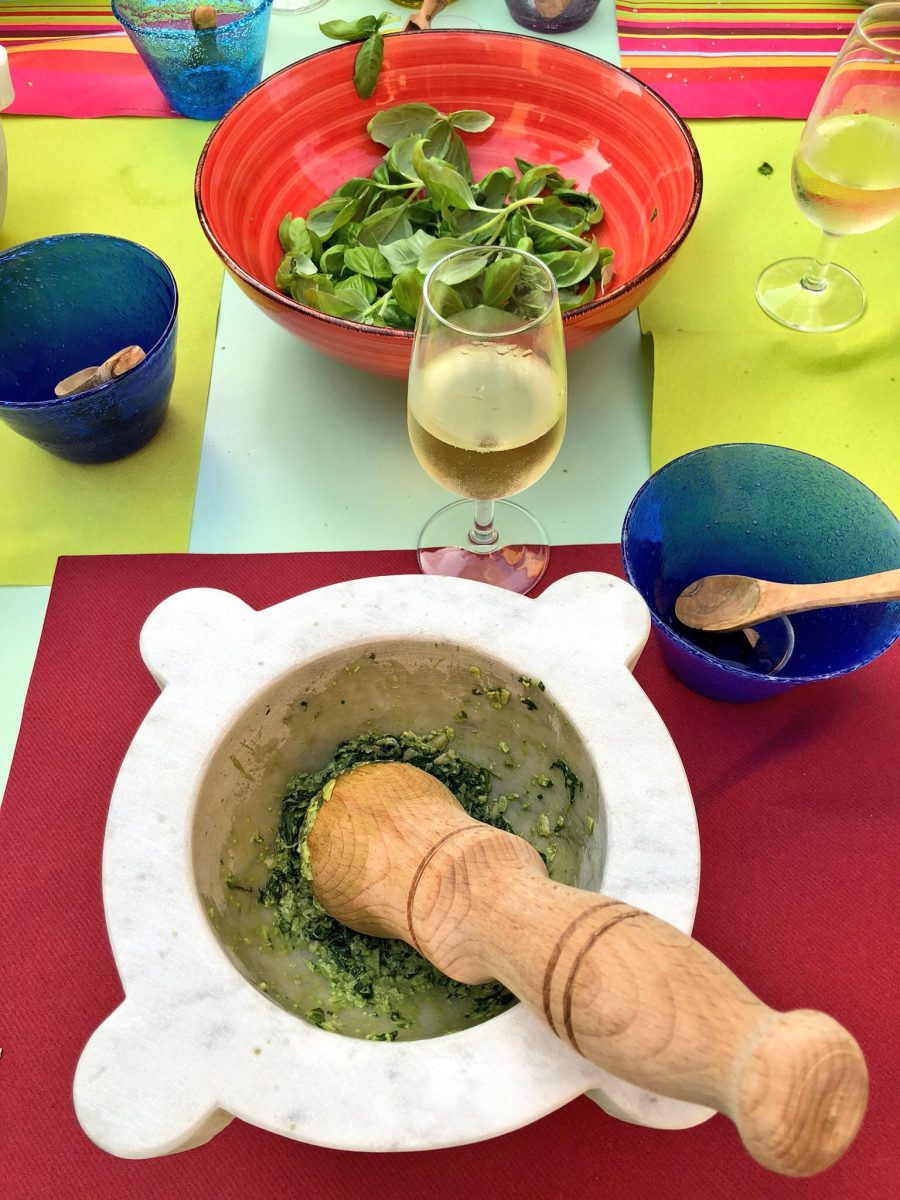
What this pesto-making class in Levanto is like
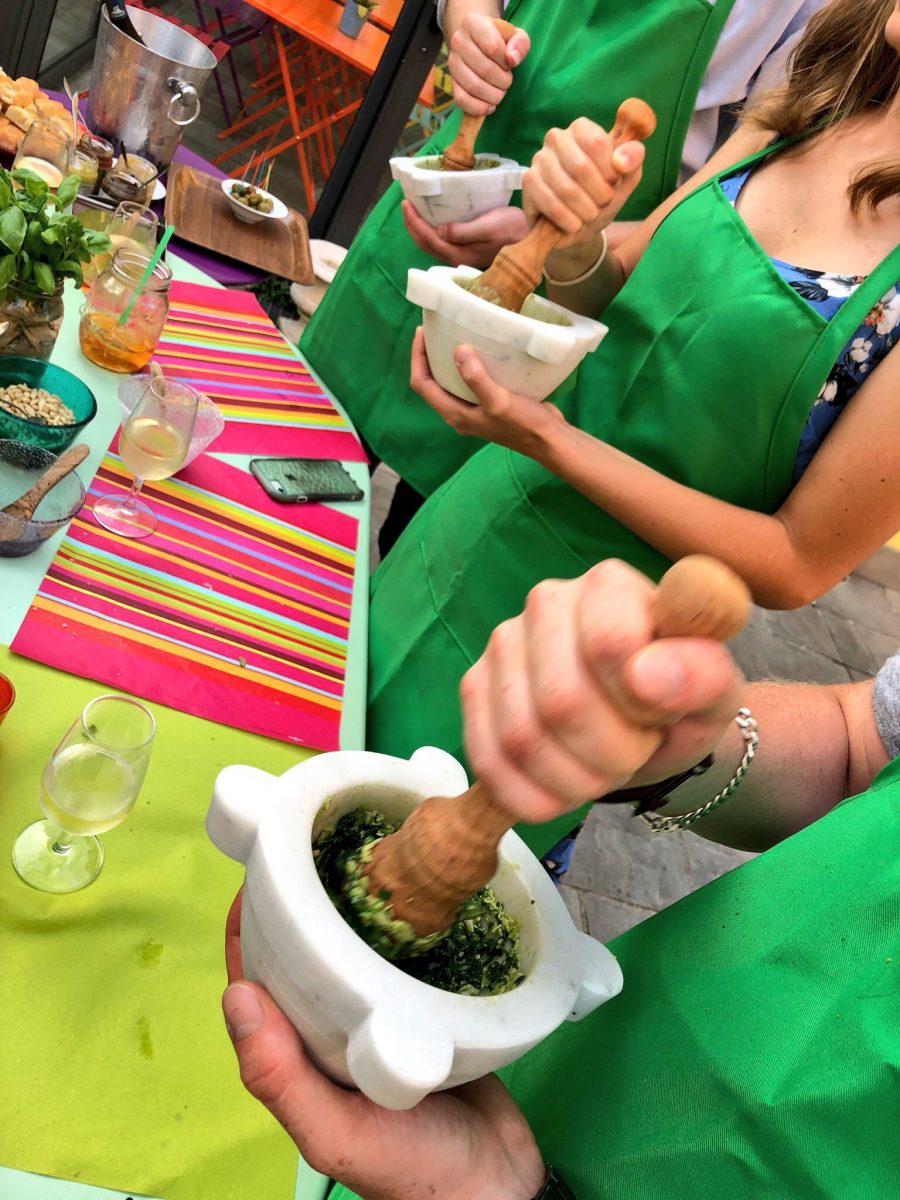
This is not a rushed cooking demo. It’s a relaxed, hands-on experience, the way pesto should be: slow, tactile, fragrant, and slightly messy in the best possible way.
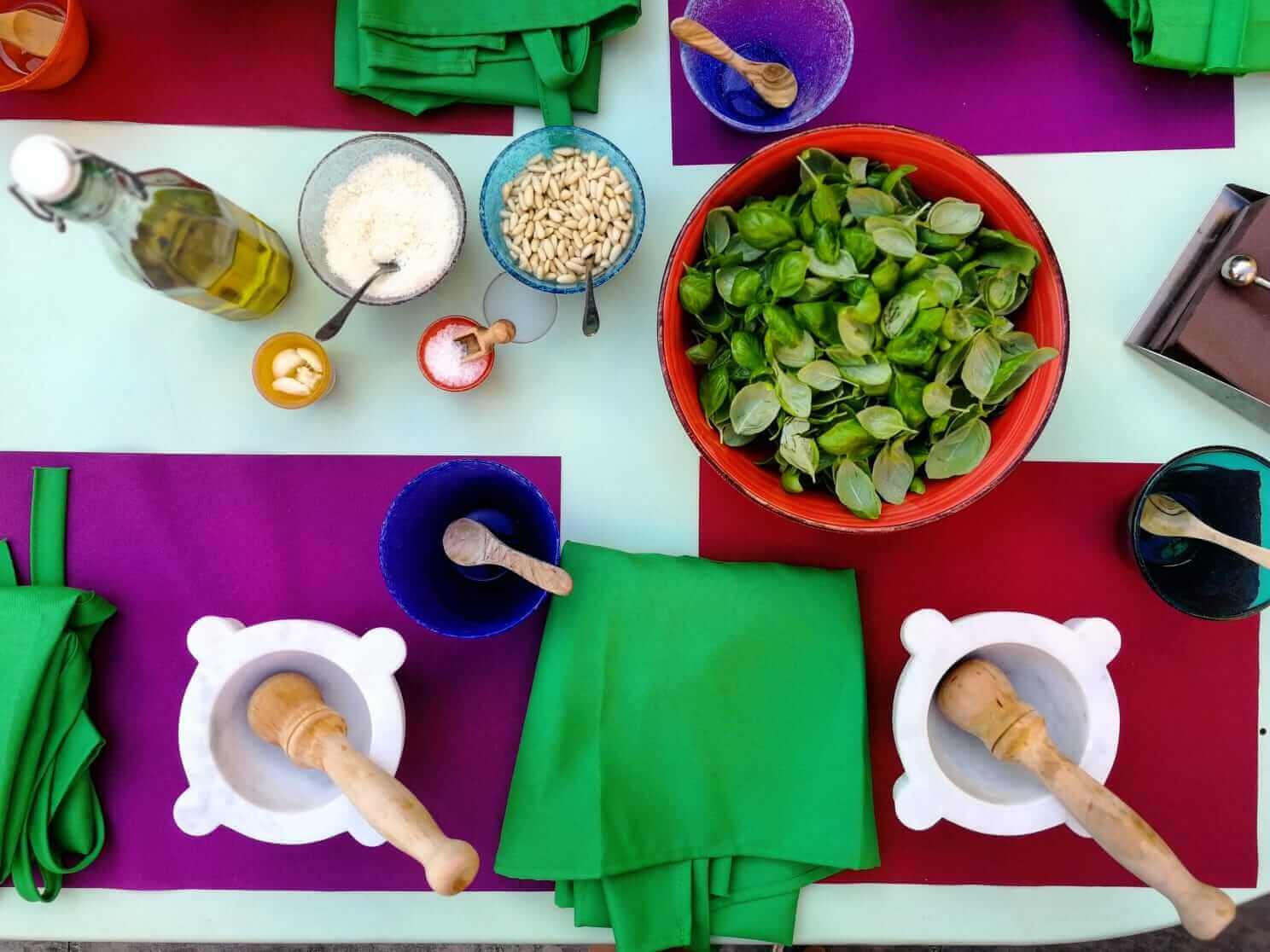
We meet at 12:30 at the Oasi Eco Boutique Hotel. You’ll sit down with your mortar and pestle, and I’ll guide you step by step, explaining not only what to do, but why we do it that way.
You’ll learn:
- how to choose basil that tastes like basil, not like salad
- why garlic matters, and how to use it without letting it dominate
- what makes a good balance between cheese, oil and aromatics
- how texture changes depending on your rhythm and pressure
- how to adjust pesto for pasta, bruschetta, focaccia, or even vegetables
And yes, we talk about pine nuts too. We use them in the classic modern way, but with the historical perspective that makes the whole thing more interesting, and honestly more human.
Why mortar pesto tastes different
If you’ve only ever made pesto in a blender, you’re in for a revelation.
A blender is fast, but it’s also aggressive. It heats ingredients, it oxidises basil, and it tends to turn pesto into a uniform cream. The mortar method is slower, but it keeps the basil’s aroma intact and gives you a texture that feels more alive.
You can smell the difference while you’re making it. It’s not subtle.
What’s included
Depending on the day and the group, the experience typically includes:
- the full pesto-making session with mortar and pestle
- tasting your pesto with a simple, local pairing (this is Liguria, so focaccia often makes an appearance)
- a little moment of “now what”, meaning practical tips on how to recreate it at home
It’s designed to be easy, friendly, and genuinely useful, not just a holiday activity you forget the moment you leave.
Who this class is perfect for
- First-time visitors to Liguria who want a cultural experience that feels real
- Cinque Terre travellers staying in Levanto who want something local, not touristy
- Food lovers who enjoy stories as much as flavours
- Solo travellers who want a warm, social experience at midday, without awkwardness
- Anyone who has ever said, “I can never make pesto like in Italy”, and wants to fix that
The small things you’ll remember
People often think they’ll remember the recipe. They do, but what they really remember is:
- the perfume of basil the moment you start working it
- the sound of the pestle against the mortar
- the first taste, and that second of silence before everyone smiles
- the feeling of doing something traditional with your own hands, in the place where it belongs
And, very often, they remember the pine nut story. Because it’s funny, and because it breaks the myth in the nicest way.
Want to join?
If you’re planning a stay in Levanto between April and November, and you’d like to make pesto with me at the Oasi, this is your sign.
Bring your appetite, your curiosity, and a willingness to get your hands scented with basil for the rest of the day. Liguria approves.
How to plan your day around the class
Since the class starts at 12:30, you can easily build a beautiful Ligurian day around it:
- Morning: beach time in Levanto or a short walk on the coastal path towards Bonassola
- Midday: pesto class at Oasi
- Afternoon: a train ride to one of the Cinque Terre villages, best enjoyed later in the day
- Evening: aperitivo and dinner by the sea
This is the kind of slow itinerary that makes the Levanto area feel less like a destination to tick off, and more like a place to actually live.

A final note on pesto and expectations
If you come to this class expecting the “perfect Instagram pesto”, bright neon green and smooth like a cream, you might be surprised.
Real pesto has texture. It smells intensely of basil and garlic. It tastes of olive oil and summer. It is not meant to look flawless. It is meant to taste alive.
And once you learn how to make it properly, you will never look at supermarket pesto the same way again.
P.S.
Did you know that there is also a World Championship of Genovese Pesto done with a mortar?
If you ever visit Genoa, you have to taste Roberto Panizza’s Genoese pesto at the Il Genovese restaurant downtown!