


One of the things that struck me most on my winter journey through Norway was how easily the landscape makes you feel as if you have slipped back in time. Snow-covered peaks, deep fjords, valleys dotted with red wooden barns, and then, rising from the countryside like dark, spiky crowns, the stave churches of Norway.
Visiting them is like stepping straight into the Middle Ages. These churches, once more than a thousand and now only 28 surviving, were built between the twelfth century and the Black Death of 1349. Each is different, some large and richly carved, others tiny and humble, but all radiate the same mix of Viking strength and quiet spirituality.
Across Norway, I put together my own itinerary to see some of the most remarkable ones, from Oslo up to Lillehammer, over the mountains to Lom, down to Røldal, and then around the mighty Sognefjord to Hopperstad, Kaupanger, Borgund and the tiny Undredal. Each stop added a layer to my understanding of Norwegian history, myth and architecture.
A note on how to travel this one
I usually travel Norway, and everywhere, by public transport. My 47-day winter journey the length of the country was done almost entirely by ferry, bus and train, on purpose, and it is the way I love best.
This trip is the exception, and worth being honest about. The stave churches are rural and scattered, tucked into valleys and along fjords that public transport reaches slowly or not at all. To string a good number of them together in a sensible route, a car genuinely is the right tool. Choosing the mode to suit the journey, rather than out of principle, is itself part of travelling independently, and this is one itinerary where I would tell you to drive. So this is a road trip, and unashamedly so.
Let me take you along the route.

Oslo: the first encounter
If you start in Oslo, your first stave church will most likely be the Gol Stave Church, reconstructed at the Norwegian Museum of Cultural History. Standing among the other historic buildings, you feel at once how central wood is to Norway’s past: as material, as craft, as shelter, as identity.
The scent of pine tar reaches you before you step inside. This tar, brushed on every five years with pig-hair brushes and dusted with charcoal, keeps the wood weatherproof, and on hot days it can drip onto your jacket. It is both practical and symbolic, a reminder of the care these buildings need to survive the centuries.
From Oslo, the road north leads deeper into stave church country.
Lillehammer and the road to Lom
A few hours’ drive brings you to Lillehammer, where the Maihaugen open-air museum shelters another stave church. But the real jewel of this leg lies further north: Lom Stave Church.
One of the largest still standing, Lom is striking, its extended nave and spires reaching skyward. Inside, fragments of medieval wall paintings survive alongside post-Reformation additions like the pulpit. It is a working parish church, and stepping in, you feel less like a tourist than a guest in a living community.
Driving through the Gudbrandsdal valley to Lom, I kept imagining medieval pilgrims making the same journey, when these churches were not only places of worship but landmarks guiding people across a harsh landscape.
Røldal: a pilgrimage stop
From Lom I turned southwest, into seemingly endless mountains and winding roads. Røldal Stave Church, built around 1250, was once a major pilgrimage site thanks to a crucifix believed to hold healing powers. It still feels different, humbler perhaps, but with a quiet magnetism.
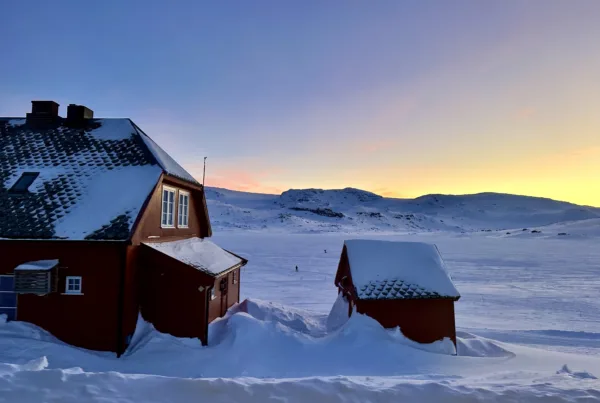
The village, snowbound in February, was utterly still. Standing outside with the church silhouetted against the white mountains, I felt I had stumbled into a forgotten chapter of time.
Hopperstad and Kaupanger: the Sognefjord giants
In the Sognefjord region the churches grow more dramatic. At Hopperstad, near Vik, the church rises like a wooden dragon, its carved portals echoing Viking ships and Norse myth. Built in the early twelfth century, it is among the oldest, and you half expect to hear a saga recited as you cross its creaking floor.
A short ferry away, Kaupanger Stave Church impressed me with its size and grace. With 22 staves it feels airy, more wooden cathedral than country church. I arrived in the late afternoon, when the fjord light turned soft and gold and warmed the whole interior against the winter chill.


Borgund: the icon
If you are picturing a stave church, you are probably picturing Borgund. Built around 1180 and perfectly preserved, it is the most iconic and most photographed of them all: the steep tiered roof, the dragon heads curling from the gables, the dark tarred wood, everything about it says medieval Scandinavia.
Walking up to it, I could not help thinking of Tolkien, and it is no surprise these churches inspired so much fantasy architecture. The small museum next door is genuinely useful, explaining stave construction and showing regional artefacts.
Undredal: the tiny gem
Not far from Borgund, down on the Aurlandsfjord, lies Undredal, a tiny village famous for its goat cheese. Tucked between coloured houses and fjord cliffs is the smallest stave church still in use, seating just 40.
I loved it not only for the church but for the contrast: after the grandeur of Borgund, Undredal felt intimate, homely. Sipping hot chocolate and looking out at the fjord in February, I decided this was Norway at its cosiest.
Bergen and Fantoft
The road finally led me to Bergen, Norway’s second city and the perfect endpoint. Just outside lies Fantoft Stave Church, originally built in Fortun in 1150, moved here in the nineteenth century, destroyed by arson in 1992 and since reconstructed.
Yes, it is a replica, but standing among the pines it still carries you back centuries, and it is a sharp reminder of how fragile wooden heritage is.
Practical tips for a stave church road trip
Best season. Late spring to early autumn, roughly May to September, is easiest. In winter, as I did it, many roads are icy or closed, but the atmosphere is hauntingly beautiful. If you drive in winter, see the note on conditions below and do not underestimate it.
Transport. A car is the right choice for this particular trip, since the churches are scattered and rural. Fjord ferries are frequent and efficient and slot into the drive. If you are hiring a car and, like many visitors, this is your first time driving abroad, it is worth choosing your destination and vehicle with a clear head.
Driving conditions. Norwegian roads are high quality and traffic is light outside the cities, but many rural roads are narrow and winding and take longer than the map suggests, and there are automatic toll booths on the main routes. In winter, snow, ice and sudden weather are the real challenge: studded tyres or chains, short daily distances and generous buffer time are essential, and some mountain passes simply close.
Tickets. Entry fees run roughly 60 to 100 NOK. Many are still active churches, so check opening hours before you arrive.
Accommodation. Fjord guesthouses, mountain cabins and small hotels give the best local feel. Book ahead in summer.
Don’t miss. The smell of pine tar, the carved dragon heads, the simple powerful interiors, and the way each church tells a slightly different story of medieval Norway.
Plan the route, then let it breathe
One thing I would say to anyone planning this, and any road trip: lock in the fixed points, then leave room to wander. Book the beds ahead in summer, note the church opening hours, and plan sensible daily distances, but leave gaps for the detour down a signposted lane, the viewpoint you did not know about, the village that asks you to stay an extra hour. That balance between a mapped route and spontaneity is, to me, the whole art of independent travel, and it is exactly how I plan every trip I take.
Why stave churches matter
Visiting stave churches is not just sightseeing; it is time travel. These are buildings where Christianity and Norse tradition overlap, where Viking carving meets medieval faith, where wood, tar and sheer determination have preserved a thousand years of history.
For me each stop was more than a tick on a list. It was a chance to slow down, breathe in the tar and pine, listen to my footsteps echo in the near-dark, and imagine the countless lives that passed through those wooden doors. By the time I reached Bergen, I felt I had traced a wooden thread through Norway’s history, one that still connects fjord villages, mountain valleys and even modern cities.
So if you are planning a Norway road trip, do not just race from fjord to fjord. Take the time to stop at a stave church or two, or ten. They are not only architectural marvels, but they are also storytellers, guardians of wood and time.

Further reading
- My 47-day independent winter journey across Norway, the trip this route grew out of
- Bergen in winter: a five-day solo itinerary
- My guide to planning independent travel, the method behind all of it
- All my trips in The North
FAQ
Of more than a thousand medieval stave churches once thought to have stood in Norway, only 28 survive today. They were built mostly between the twelfth century and the Black Death of 1349, and range from large, richly carved churches like Lom and Borgund to tiny ones still in parish use, such as Undredal.
Borgund Stave Church, built around 1180 and beautifully preserved, is the most iconic and most photographed, with its tiered roof, dragon-head gables and dark tarred wood. It is often the image people picture when they think of a stave church, and it has a small museum alongside explaining the construction.
For a proper stave church road trip, yes. The churches are rural and scattered across valleys and fjords that public transport reaches slowly or not at all, so a hire car, combined with the frequent fjord ferries, is the practical way to link several in one route. Individual churches near cities, such as the reconstructed Gol church in Oslo, can be reached without one.
Late spring to early autumn, roughly May to September, offers the easiest driving and the most reliable road access. Winter is possible and atmospheric, as I found in February, but many rural roads are icy or closed, so it demands studded tyres or chains, short daily distances and careful planning.
A classic route runs from Oslo north to Lillehammer and Lom, over the mountains to Røldal, then around the Sognefjord to Hopperstad, Kaupanger, Borgund and Undredal, ending in Bergen. It combines several of the finest surviving churches with some of Norway’s most spectacular fjord and mountain driving.