


El Rocío is different. It is a small parallel world in the heart of Andalusia, and I love it deeply.
I put off writing this for years because I am jealous of it. I know that is silly. But when you fall for a place, and it becomes the refuge you go to refuel, you want it to stay exactly as it is, and writing about it feels like handing it over.
I am writing it now anyway, because it deserves to be understood, and because loving a place also means being honest about what threatens it.
How I ended up loving a village in the marshes
El Rocío is a dusty village at the end of the road, the marshes on one side and, far off, the Portuguese border on the other. For most of the year, it is quiet. Then, at Pentecost, a tide of pilgrims arrives on horseback, on foot and by cart to worship the Blanca Paloma, the White Dove, in one of the largest pilgrimages in Europe.
My brother moved here almost by accident. He was driving to Conil de la Frontera, stopped for the night, woke up in a place that looked like a film set, and simply stayed. His first messages to me were photographs of a village straight out of a Western, then a short video of Lusitano horses in front of the great white church. That was all it took. I thought: this is somewhere I need to see.
I have been flying back ever since, whenever I can, to slow down and step out of the world for a while.
What El Rocío is actually like
El Rocío belongs to the municipality of Almonte, a short drive away, in the province of Huelva. It sits at the very edge of the Doñana wetlands, and it is the main gateway into the national park.
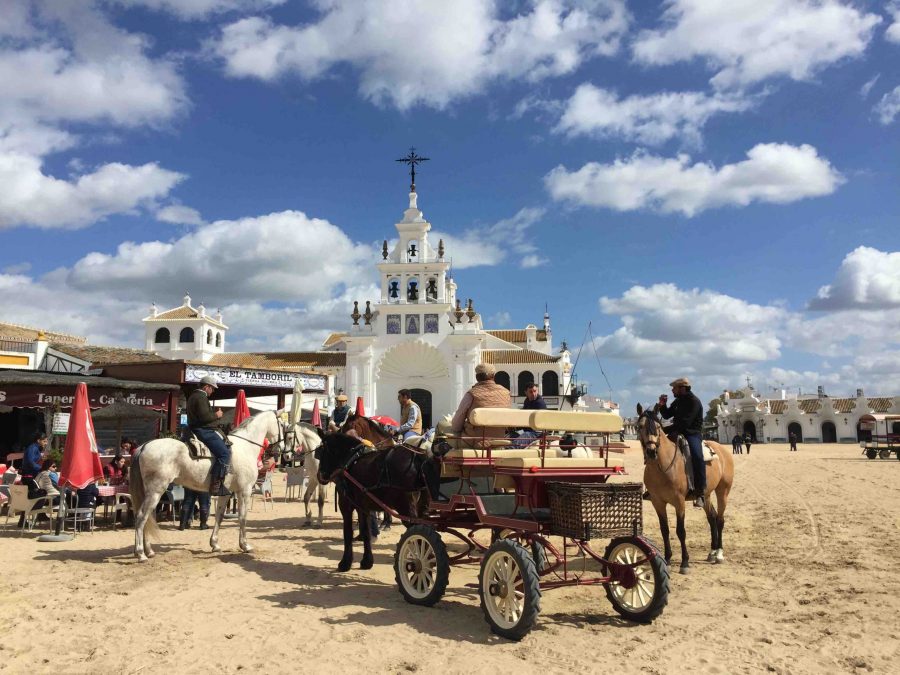
It is a place where horses take priority over everything. The streets are sand, not asphalt. Low white houses with flower-hung balconies line them, each with cast-iron columns, courtyards and a rail to tie up a horse. The brotherhood houses stand at every corner, cowboy boots and ruffled Sevillian dresses everywhere, guitars playing day and night at the weekends, the smell of candle wax drifting out of the church, and beer that costs almost nothing.
You do not have to be a rider or a believer to find it worth the trip. It is unlike anywhere else in Spain.


Things to see in El Rocío
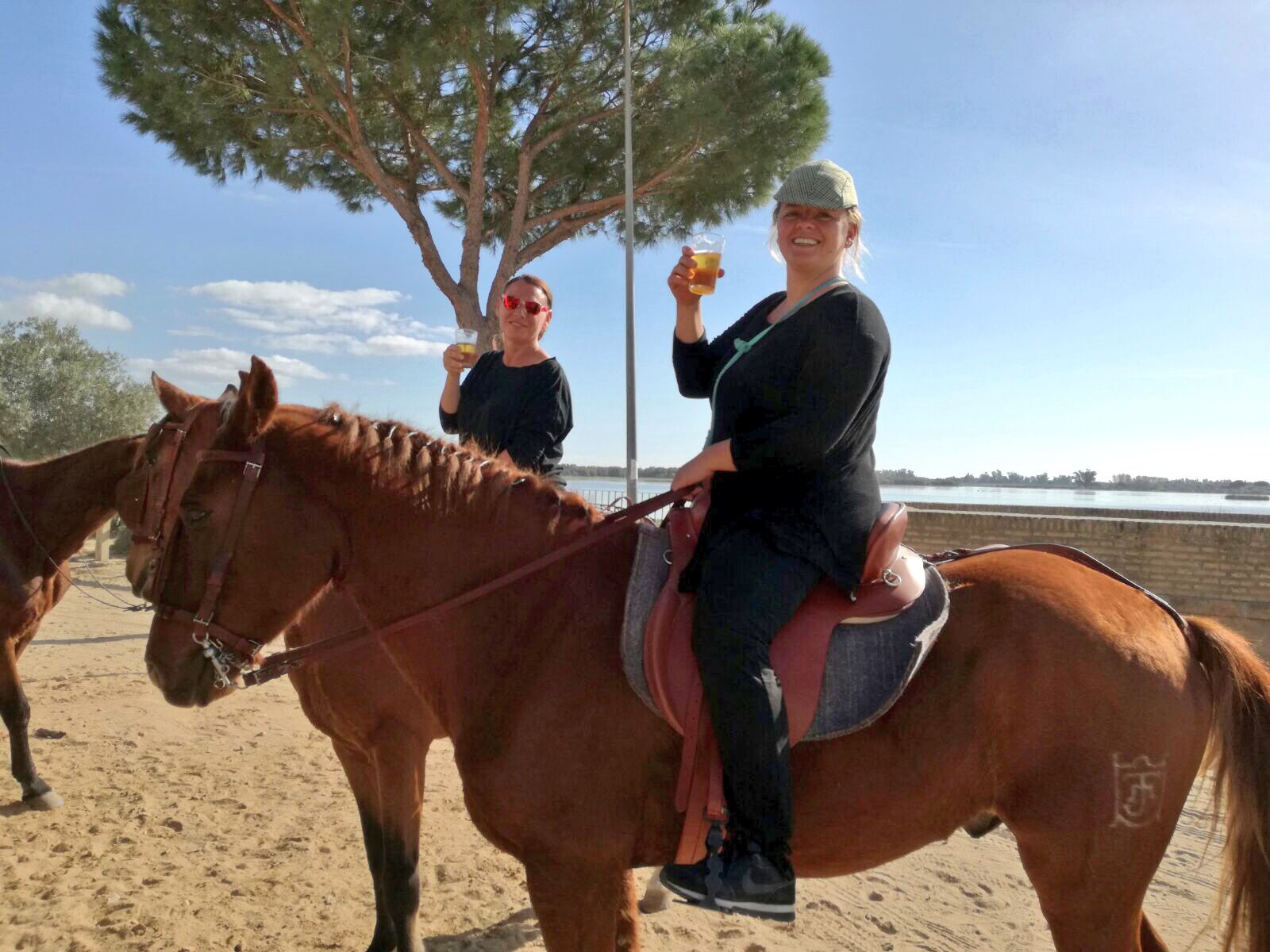
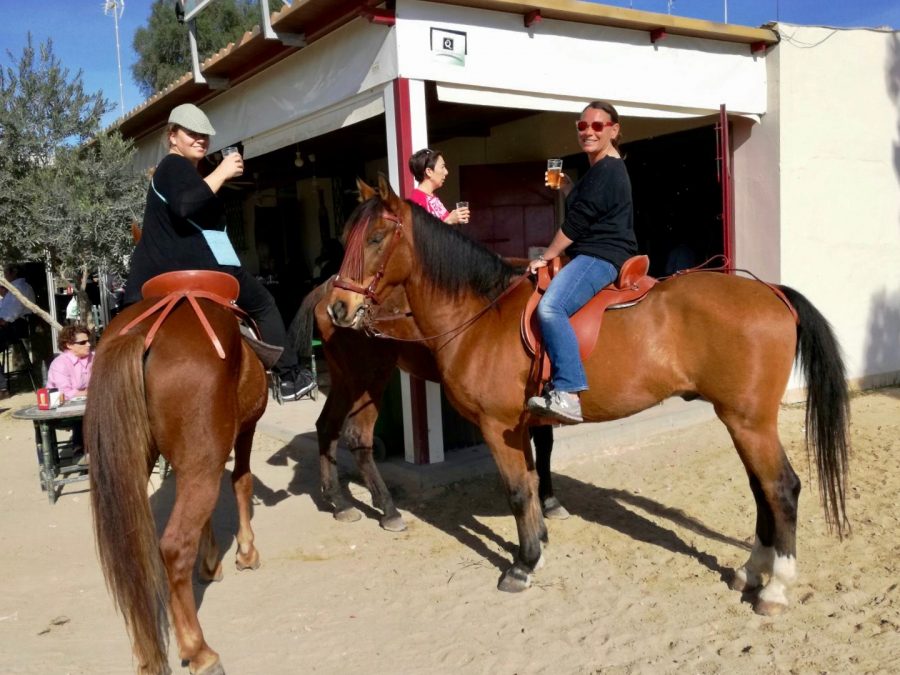
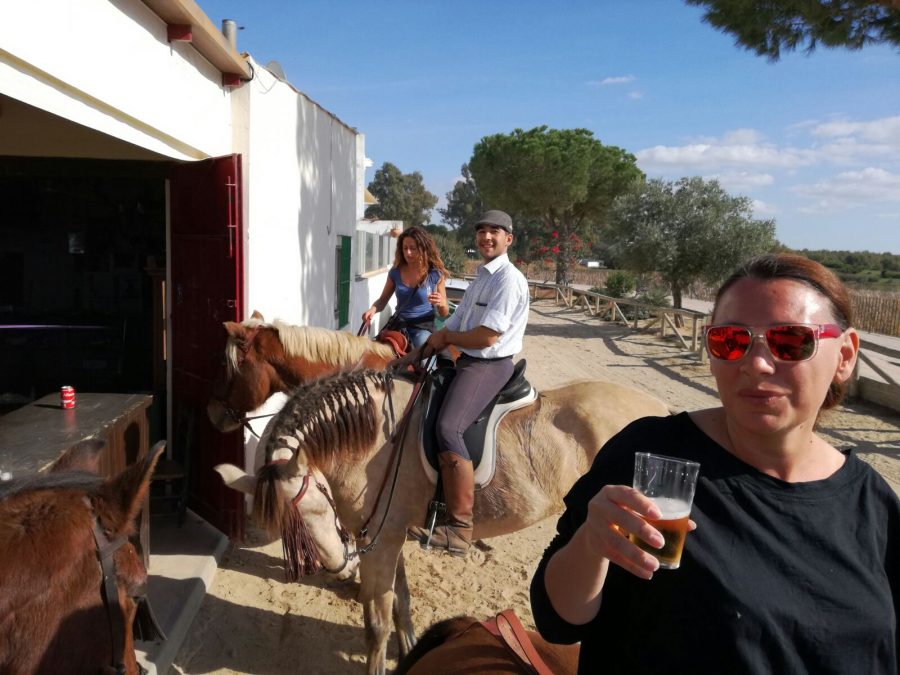
The first thing to do is simply walk, slowly, from one sandy alley to the next, taking in the details of each little house, the public training rings dotted about, and the extraordinary sight of someone drinking a cold beer at the bar without getting off their horse.
The Hermitage. Begin at the dazzling white Hermitage of El Rocío, a monumental church built like an Andalusian farmhouse between 1963 and 1969, which draws over a million visitors a year. Inside, the baroque altarpiece holds the most venerated image in all Andalusia, Our Lady of El Rocío, dressed in rich fabrics in the style of the old Austrian court.
The candle room. Across the street is a room where people queue to light wax candles. Thousands of them burn at once, the walls and ceiling blackened by the smoke, the heat, the smell and the devotion filling the space. I am agnostic, and I have always found it genuinely moving.
Around the village. The City Hall occupies a former Dominican convent. The Marismillas Palace, in the heart of the village, is a favoured retreat of Spanish prime ministers and visiting heads of state. And the Plaza del Acebuchal, ringed with bars and hotels, is presided over by an enormous, centuries-old wild olive tree, with several more nearby almost as vast.
The Ajolí Bridge. Just before you enter the village, you cross the Puente del Ajolí, where pilgrims traditionally gather to sing, and where the pavement is set with plaques naming the brotherhoods that pass over it on their way to the Blanca Paloma.
Birdwatching. The Paseo Marismeño path runs along the edge of the marshes, and the Francisco Bernis Bird Observation Centre, a few hundred metres from the Hermitage, will lend you good binoculars and point you towards the flamingos, though how much water and how many birds you see now depends entirely on the state of the wetland, which I will come to.



Horses in El Rocío
Horses are the whole point, for me. El Rocío has been officially named Aldea Internacional del Caballo, the International Horse Village, since 1992, and it feels it.
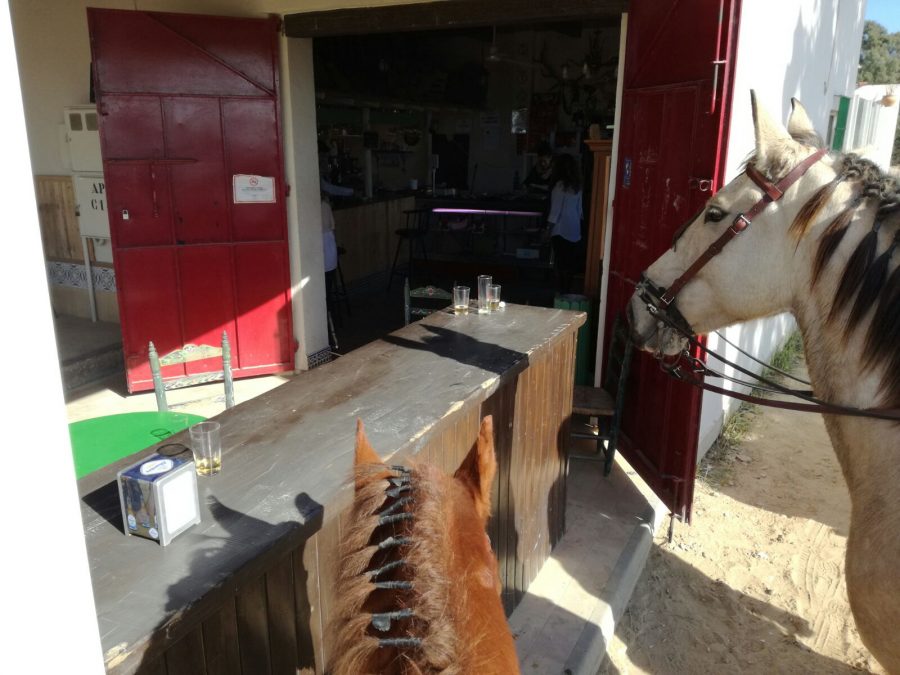
You notice it the moment you arrive. The sandy streets and squares are made for horses and carriages, which move through them freely. The bars have outdoor tables set at the right height for a rider to eat and drink without dismounting. To me, this is a small vision of paradise.
Unless you actively dislike horses, take a ride out towards the entrance of the Doñana park, along the pilgrims’ Raya Real road, through the pine woods of El Chaparral to the Vado del Quema. It is calm and beautiful, and you may see deer and other wildlife along the way. You can book through the tourist office in the village or your hotel.

Saca de las Yeguas
One of the oldest horse traditions in Europe happens here every year at the end of June. In the Saca de las Yeguas, the mares and foals of the semi-wild herds are gathered from the Doñana marshes and driven through El Rocío to Almonte, where the foals are marked and their manes and tails trimmed. A few are sold, and most are returned to the marshes. In 2026, it falls, as ever, around the 26th of June.


La Romería de El Rocío
The great pilgrimage takes place each year on the weekend before Pentecost Monday, so the date varies. In 2026, it ran from around 20 to 25 May. For 2027, count back from Pentecost, and if you plan to go, book many months ahead, because almost a million people converge on a village of fewer than two thousand.
Pilgrims arrive along several historic caminos: the Sanlúcar road from Cádiz, which crosses the Doñana park itself, the road across the plains from Almonte, the Moguer road from Huelva, and the road from Seville. The emotional peak comes in the small hours of Monday, when the Virgin leaves the sanctuary and is carried on the shoulders of the crowd, to cries of ¡Que viva la Blanca Paloma!.
There is also a rarer event. Every seven years the image is carried the fifteen kilometres to the church in Almonte, dressed not as a queen but as a shepherdess, in a seventeenth-century travelling costume. The tradition dates from 1813 and gives thanks for the town’s deliverance from Napoleon’s troops.

Doñana: the hard part
I cannot write about El Rocío honestly and leave this out, because the marshes that make the village what it is are in serious trouble.
Doñana is one of the most important wetlands in Europe, a UNESCO World Heritage Site and a vital staging post for millions of migrating birds between Europe and Africa. It is also drying out. A long drought, made worse by climate change, has combined with something more culpable: the intensive strawberry and berry farms that ring the park, which produce a huge share of Europe’s red fruit and draw down the same aquifer that feeds the lagoons, often through illegally drilled wells.
The consequences are stark. In early 2024 the park recorded its lowest overwintering waterbird count since records began in 1973. Its largest permanent lagoon, Santa Olalla, dried out completely for three years running. UNESCO has repeatedly warned Spain to act.
There is some better news, and it is worth holding onto. Since 2024, nearly three hundred illegal wells have been sealed, and plans to legalise more irrigation have met fierce resistance. And the Iberian lynx, the park’s emblem and once the most endangered cat on earth, has recovered remarkably, its numbers across Spain and Portugal roughly doubling since 2020, and its status has been downgraded from endangered. Proof, if needed, that these places can come back when properly protected.
Why put this in a love letter to a village? Because loving a place is not the same as looking away from what endangers it, and because a visitor who understands what is at stake is a better visitor. If you go, go gently, and know what the water beneath those marshes is really worth.

Visiting the park
You can only enter the protected core of Doñana on a guided tour, from group trips to private ones, and you should book well ahead. Choosing a responsible, well-run operator matters more here than in most places.
Where to stay
I can recommend two places. The Pequeño Rocío, just outside the village, is a larger hotel with rooms and apartments in various sizes. The first time, I took a two-floor apartment with my father, roomy and comfortable, with a basic breakfast but an excellent dinner. The Hotel La Malvasía is more intimate and romantic, an old manor house right in the centre with its own stables, facing one of the public equestrian fields where you can watch Andalusian horses train for hours.


Where and what to eat
The food is classic Andalusian, and I would steer you towards the prawns, langoustines, and seafood. My favourite dishes are the local soups: the goose-based Sopa Marismeña, the Sopeao, a close cousin to gazpacho, and the hearty Almonte stew. And there are alfajores filled with dulce de leche.
Among the places I like: Restaurante Toruño, on the Plaza del Acebuchal, with beautiful stained glass and marsh views; Restaurante Cristina, for grilled meat and seafood and excellent soups; La Taberna del Rey, ideal for a stop on horseback, good sandwiches and a cold lager; Bar La Garrocha, on the main square, for a quick drink or tapas; and Restaurante Aires de Doñana, across the marsh, looking back at the water and the Hermitage.



Around El Rocío
There is plenty within a short drive. Almonte has a pretty historic centre and the Museo de El Rocío, which is the right place to start before visiting Doñana. Matalascañas and the coast bring long Atlantic beaches, dunes and pine woods, good for walking and surfing, with the Dunar Park and its marine museum nearby. Scattered along the Huelva coast stand a series of watchtowers built under Philip II and Philip IV to guard against pirates. And Seville and Huelva are both within easy reach.
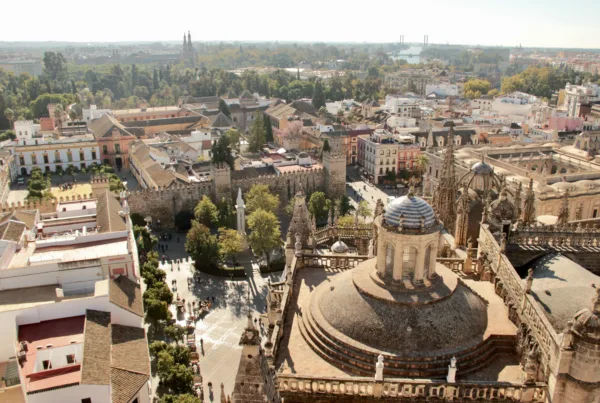
If you want the city that anchors this whole region, I have written a separate, personal guide to Seville. And if it is the horses that draw you, El Rocío sits among my favourite horse-riding escapes.


Further reading
- My guide to Seville, an hour up the road
- Doñana guided tours and reservations, the official booking site for the park
- SEO/BirdLife on the fight to protect Doñana, if you want to understand the wetland’s plight
FAQ
El Rocío is a village in the municipality of Almonte, in the province of Huelva, Andalusia, at the edge of the Doñana wetlands. Its streets are sand rather than asphalt, horses move freely through them, and it is famous for the Romería del Rocío, one of the largest pilgrimages in Europe.
The Romería del Rocío takes place on the weekend before Pentecost Monday, so the date changes each year. In 2026, it ran from around 20 to 25 May. Almost a million pilgrims travel to the village on foot, on horseback, and in decorated wagons, and if you plan to visit, you should book accommodation many months in advance.
Yes, and it is a very different, far quieter experience. Outside the Romería, El Rocío is a peaceful village of sandy streets, white houses and horses, well worth visiting for its atmosphere, its birdwatching on the edge of Doñana, and rides out towards the national park. You do not need to be religious or a rider to enjoy it.
Doñana is one of Europe’s most important wetlands and a UNESCO World Heritage Site, home to the Iberian lynx and millions of migrating birds, and it is well worth visiting on a guided tour. It is also under serious pressure from drought and from intensive agriculture drawing down its aquifer, so visiting responsibly, with a reputable operator, matters.
Buses run to El Rocío from Seville in an hour, and from Huelva via Almonte, for under ten euros with Damas. A car gives more freedom to explore the Doñana area and the coast. El Rocío sits roughly between Seville and Huelva, at the edge of the marshes.