

A holiday in the Maremma is exactly what I long for when I need Tuscany without the crowds, because the Tuscan Maremma has everything I love: historic villages, art, a wild sea, wildlife, wonderful horses, food and wine, thermal baths, and silence.
If you follow me, you know I go often, even off-season, and fall for it a little more each time. Over many visits I have pieced together my ideal itinerary, and here it is.
The tuff towns of the Maremma
You meet a beautiful village every few kilometres here, and ideally I would have you stop at all of them, even just for the square, the church and the medieval walls. That is how I came to love quiet Manciano, Scansano and Magliano. But a few you simply cannot miss.

Pitigliano
Getting to Pitigliano is awkward, far from everything and poorly connected, and then it takes your breath away, revealing itself all at once around a bend. Carved from the tuff, the town seems to grow out of the rock it stands on, chameleon-like and utterly beautiful. Its emblems are the Medici aqueduct and the old Jewish quarter that earned it the name Little Jerusalem.
Get lost in the labyrinth of alleys, browse the little shops, and visit Palazzo Orsini, the cathedral and the ghetto. Outside the town, the Etruscan necropolis and the Vie Cave are extraordinary: mysterious sunken paths cut into the rock, in places twenty-five metres deep. Further out, stop at Poggio Rota, a megalithic site sometimes called a tiny Stonehenge, a place made for watching the sky.


Sorano
The last time I visited I was soaked through, and then the sun returned in time for a cinematic sunset. But Sorano is a natural film set in any weather. Walk between the mighty Fortezza Orsini, the Collegiata, the church of San Nicola, the Palazzo Comitale, the clock tower above the Masso Leopoldino, and the Porta dei Merli, and you get photogenic views and history at every turn. Do not miss the rock complex of San Rocco, the Vie Cave, and the cave settlement of Vitozza, some two hundred caves within an archaeological park.
Sovana
Another village that sets my imagination flying; I could happily watch an episode of Game of Thrones filmed here. You enter through the ruins of the great Aldobrandeschi fortress and cross the town along the characterful Via del Pretorio, lined with artisan shops, into a lovely square with a beautiful stone pavement. See the Palace of the Archives, the late-Romanesque church of Santa Maria, the early-Christian church of San Mamiliano, and the Palazzo Pretorio, then the house of Pope Gregory VII, born here as Hildebrand of Sovana, and the Gothic-Romanesque Duomo. The Vie Cave here link the ancient settlements and necropolises of Sovana, Pitigliano and Sorano.


Montemerano
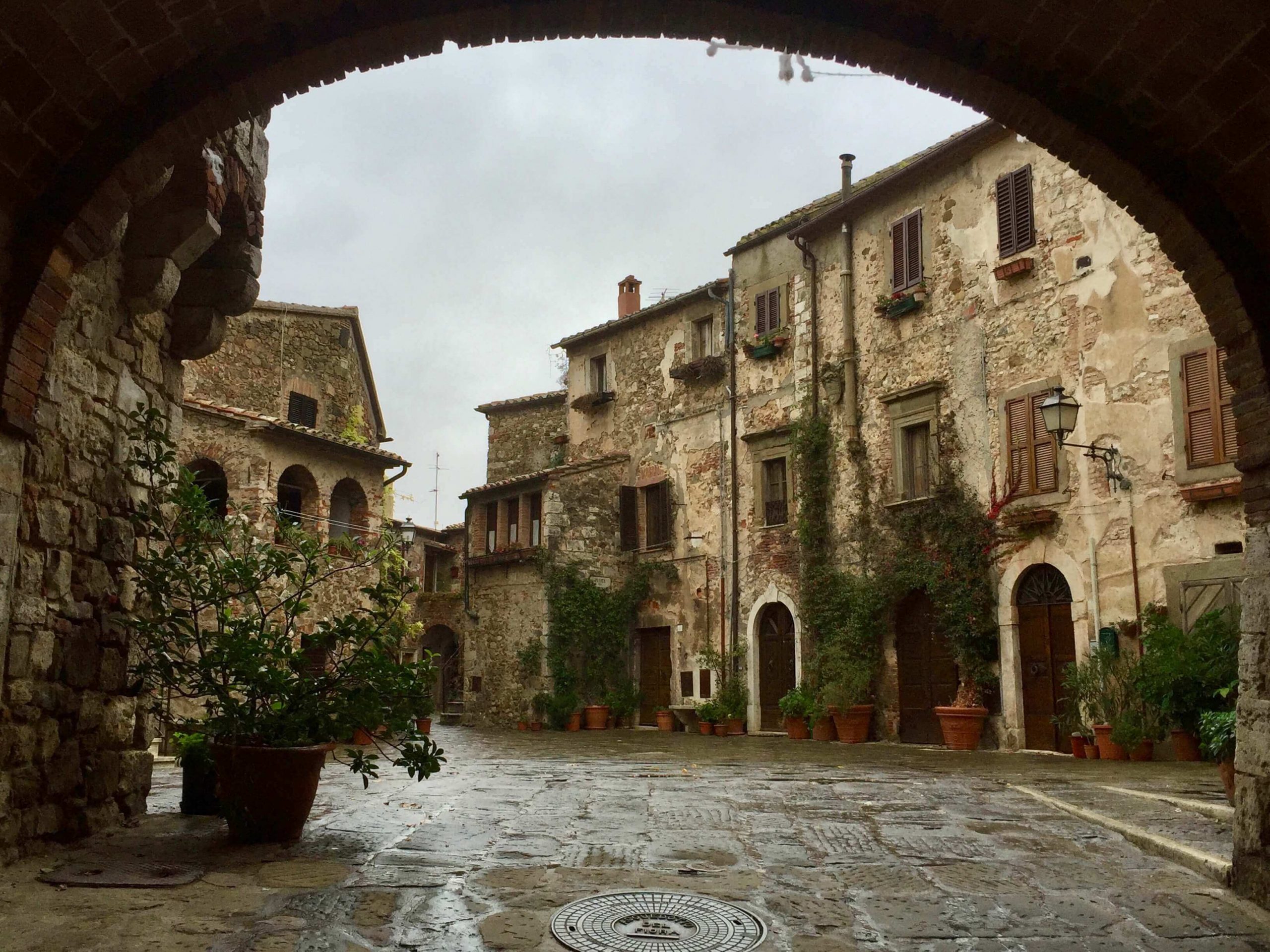
Montemerano is simply perfect, set high on a hill over the Maremma behind three rings of ancient walls, deservedly named among Italy’s most beautiful villages. Lose yourself among the narrow lanes, tiny squares, flower-filled balconies, fine restaurants and art studios; see Piazza del Castello and the Romanesque church of San Giorgio with its Sienese-school frescoes. Take your time. Breathe the moss on the walls and the scent of flowers, and listen to your footsteps on the stone. Montemerano is special.
The thermal baths
Say spa in Tuscany and you say Saturnia. You have two ways to take its 37.5-degree sulphur water: the free natural travertine pools of the Cascate del Mulino, or the smart Terme di Saturnia spa resort. I love the free falls best, steam blurring the countryside all around. I have written all about both, and how to visit them well, in my dedicated Saturnia guide.
The wild coast: the Argentario
The Maremma’s beaches are wild and seem to run on forever, but I left my heart on the Argentario, almost an island, joined to the mainland by two sandy tombolos, Feniglia and Giannella, and the causeway across the Orbetello lagoon.
The coast is jagged and beautiful, its coves hard-won and clear as glass, ideal for snorkelling, diving and sailing. History-lovers are spoilt too: Roman and Etruscan traces around Porto Santo Stefano, Talamone and Ansedonia, then Aldobrandeschi and Orsini fortresses, the Sienese and finally the Spanish. Do not miss the fortresses, walk down to the hidden coves, and drive the panoramic road between Porto Santo Stefano and Porto Ercole, allowing plenty of time for photo stops and a stretch of rough unpaved road. Offshore wait the islands of Giglio and Giannutri.


Practical tips
The Maremma is, luckily, still wild and relatively remote. You cannot rely on public transport, so hire a car, and do not leave accommodation to the last minute, out here you can spend hours driving from one full village to the next in search of a bed. Book ahead, and, if you can, come off-season, when the light and the silence are at their best. And do visit lively Grosseto, the region’s capital.
Frequently asked questions
The Maremma is the wilder, southern part of Tuscany, known for its tuff-carved hill towns (Pitigliano, Sorano, Sovana, Montemerano), the mysterious Etruscan Vie Cave sunken roads, the thermal springs of Saturnia, a rugged unspoilt coast around the Argentario, excellent food and wine (Morellino di Scansano), wildlife and horses. It is far quieter and less touristy than northern Tuscany.
The essential tuff towns are Pitigliano (the dramatic “Little Jerusalem” with its Jewish quarter), Sorano (a natural film set with its Orsini fortress and cave settlements), Sovana (tiny and beautiful, birthplace of Pope Gregory VII) and Montemerano (one of Italy’s most beautiful villages). Combine them with the Vie Cave, Saturnia and the Argentario coast.
Yes. The Maremma is rural and relatively remote, with limited public transport, so a hire car is essential to explore the hill towns, the Vie Cave, Saturnia and the Argentario coast at your own pace. Book accommodation ahead, especially in summer, as it is spread out and fills up.
Spring and autumn are ideal, with pleasant weather, thinner crowds and the countryside at its best; the thermal baths of Saturnia are wonderful year-round thanks to the constant water temperature, and especially atmospheric in the cooler months. Summer is good for the coast but busier; the region rewards off-season, slow travel.
The Argentario offers wild coves and clear water for swimming, snorkelling, diving and sailing, the scenic drive between Porto Santo Stefano and Porto Ercole, hilltop fortresses, the Orbetello lagoon with its birdlife, and boat trips to the islands of Giglio and Giannutri. It combines beautifully with the inland tuff towns and Saturnia for a varied Maremma holiday.
Further reading
- The dedicated guides: the thermal baths of Saturnia and the wines of the Maremma
- Where to stay: Borgo Magliano Resort
- More Tuscany: visiting Lucca and the archaeology of Baratti and Populonia