


An editorial note before you read (updated 2026). This is a guest account by my friend Roberta, of a summer family road trip around Iceland some years ago. I have kept her lovely telling of it, but a few things have changed since, so read it as a travel tale rather than a current logistics guide. WOW air, the budget airline she flew, went bankrupt in 2019 and no longer exists, so compare current carriers (Icelandair, the newer PLAY, and various European airlines) for fares. Iceland’s prices have risen considerably, so treat all the figures below as of their time. And, importantly: since 2021 the Reykjanes peninsula, where the Blue Lagoon and the town of Grindavik sit, has been volcanically very active, with repeated eruptions (the most recent in July 2025, and more expected). The Blue Lagoon remains open but has closed briefly and at short notice as a precaution during eruptions, and Grindavik is largely off-limits; the rest of the country, and Keflavik airport, have been unaffected. Always check the Icelandic Met Office and SafeTravel.is before you go. Now, over to Roberta.
In August, I followed a dear friend’s family trip around Iceland, waiting day by day for her photos, until little by little I fell for the country myself. I could not resist asking her to tell you about it.
Roberta’s family trip
Iceland bewitched us. A country so primitive and authentic it seems to step straight out of a geography textbook: fairy-tale landscapes and thundering waterfalls, restless geothermal fields and drifting icebergs, the strange dance of light and dark, horses galloping mane-to-the-wind at the foot of a volcano, sheep suspended between sky and sea, and the kindness of the islanders. All of it is pressed into the hundreds of photographs we took.
We flew from Milan Malpensa (treating ourselves to a rare direct flight) and landed at Keflavik just before one in the morning, the sky still not properly dark. The airport was small and well organised, and the Hertz desk, open around the clock, handed over the little car we had booked from Italy. We drove straight to our first guesthouse in Reykjanesbaer, where, as arranged, the key was waiting in an envelope by the door.


The Blue Lagoon and the Golden Circle
We began our “journey to the centre of the earth” at the much-photographed Blue Lagoon, then set off on Iceland’s classic route, the Golden Circle, an easy loop that puts you in touch with the essential Iceland. First Þingvellir, seat of the ancient Icelandic parliament and the rift where the North American and Eurasian tectonic plates pull apart; then the geothermal field of Geysir, where Strokkur fires a jet some thirty metres high every few minutes; and finally mighty Gullfoss, one of Iceland’s colossal natural wonders.
South coast: Skógafoss to Jökulsárlón
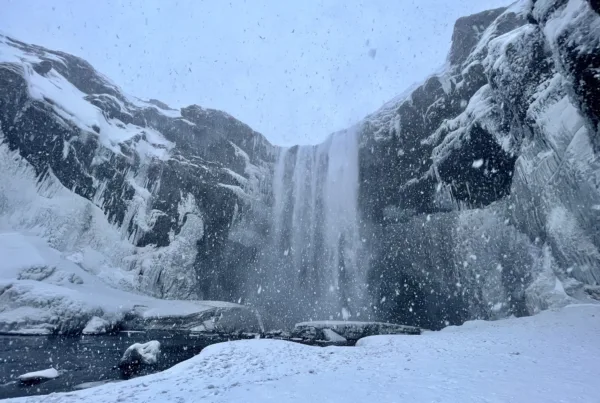
Heading south we met the beautiful waterfalls of Seljalandsfoss and Skógafoss, colours and landscapes so unreal I half-suspected a screensaver. At the Dyrhólaey headland we watched puffins (in summer) and the magic of black on white: white surf shattering on black sand and black basalt stacks rising like organ pipes. On along the coast came the vast Eldhraun lava field, the desert sands of Skeiðarársandur, and then Skaftafell, a green oasis at the foot of the Vatnajökull glacier. At Jökulsárlón we watched a unique spectacle: great icebergs calving from the glacier and drifting slowly out to sea.


North: Dettifoss, Mývatn and Krafla
The journey continued north to the thunderous Dettifoss, and then to the Mývatn area, where the solfataras of Námafjall (Hverir) steam and bubble as if from the pages of Dante: mud pools and fumaroles, intensely active. Nearby is the Krafla volcanic area, with its geothermal power station, the Víti crater and the Leirhnjúkur lava fields, a place where you really feel the earth at work. (Roberta’s original note here confused this with the Katla volcano; it is Krafla, near Mývatn, that has the power plant and the walkable geothermal sites.)
Whales, Goðafoss and the road back
One morning we set out from Húsavík with Norðursigling in search of whales, almost to the horizon, and the sight of a spouting whale and its great tail sliding under the waves is one of the most thrilling things I have ever seen. Back on the road we reached Goðafoss, the “waterfall of the gods”, where the river Skjálfandafljót drops in a broad curve. Then on to Glaumbær, with its turf-roofed farmhouses, a picturesque sunset at Sauðárkrókur, and, the next day, the powerful hot spring of Deildartunguhver and the horse-breeding country of Skagafjörður, before the tunnel under Hvalfjörður brought us at last to Reykjavík.


Planning an Iceland road trip
- Book accommodation before you go; do not waste precious time hunting for rooms on the road.
- Pack for four seasons in a day: waterproofs, fleece and warm layers, good hiking boots, and a swimsuit for the thermal pools. Bring sunglasses, and a sleep mask, since in summer it barely gets dark and windows often have only thin curtains.
- Offline maps are invaluable where there is no signal.
- Prices are high across the board, so budget generously, especially for fuel, car hire and eating out.
Icelandic food to try
Icelandic cooking leans on seafood (cod, herring) and lamb; smoked lamb with caramelised potatoes and red cabbage is a classic. For the brave there is hákarl, fermented shark, buried for months until it turns (and smells) of ammonia, traditionally chased with a shot of the caraway spirit brennivín. Roberta, to her credit, tried everything


A personal note from me (Silvia)
Iceland is not just a destination, it is an experience, and its unpredictable weather and staggering landscapes teach you to stay flexible and present. Nothing beats the freedom of pulling over wherever the view stops your breath, which happens constantly. For that reason, if you want maximum freedom, an RV or camper is a wonderful way to do Iceland, waking to a new vista every morning. I have since driven the full ring road myself, in deep winter, which is a very different and equally magical trip, and I have written about that separately.
Until next time, land of fire and ice.


Frequently asked questions
To drive the full Ring Road (Route 1) comfortably, allow at least 7 to 10 days, more if you want to add the Westfjords, the Snaefellsnes peninsula or plenty of hikes. A week is enough for a fast loop of the highlights; longer lets you travel at Iceland’s own unhurried pace, which the country rewards.
As of 2026 the Blue Lagoon is open, but since 2021 the Reykjanes peninsula has seen repeated eruptions, and the lagoon has closed briefly and at short notice as a precaution during activity, while the nearby town of Grindavik is largely off-limits. The rest of Iceland and Keflavik airport have been unaffected. Always check the Icelandic Met Office and SafeTravel.is before your visit.
Summer (June to August) brings long daylight, open highland roads and puffins, and is best for the full Ring Road. Winter offers the northern lights, ice caves and a stark beauty, but shorter days and tougher driving. Spring and autumn are quieter shoulder seasons. Choose according to whether you want midnight sun or the aurora.
For the paved Ring Road and the main sights in summer, a normal car is fine. You need a 4×4 for the interior “F-roads” of the Highlands, and in winter a robust vehicle with proper tyres is strongly advised, as conditions can be severe. Match the car to your route and season, and check road.is for conditions.
Iceland is one of Europe’s most expensive countries, particularly for accommodation, car hire, fuel and eating out. Prices have risen significantly in recent years, so budget generously, self-cater where you can, and book flights, car and lodging well ahead for the best value.


Further reading
- My own winter version: driving the full ring road, and reimagining it by sea
- Where Iceland belongs on my map: The North, slow winter travel in Lapland, Scandinavia and the Arctic
- Official safety and conditions: the Icelandic Met Office and SafeTravel.is