


Clouds of steam, raised for kilometres by the sheer power of the falls, wrap everything until you feel suspended. Clouds of brightly coloured butterflies. Clouds of flowers. Clouds of light and colour reflected on the water. Clouds made of pure emotion.
That is the first thing I remember about Iguazú, and the last. Few places on earth have left me so completely undone. This is my guide to the falls and the strange, three-country corner of the world they belong to: what to see on each side, how to cross between them, and the honest, up-to-date practicalities you’ll want before you go.

Iguazú Falls and the Triple Frontier
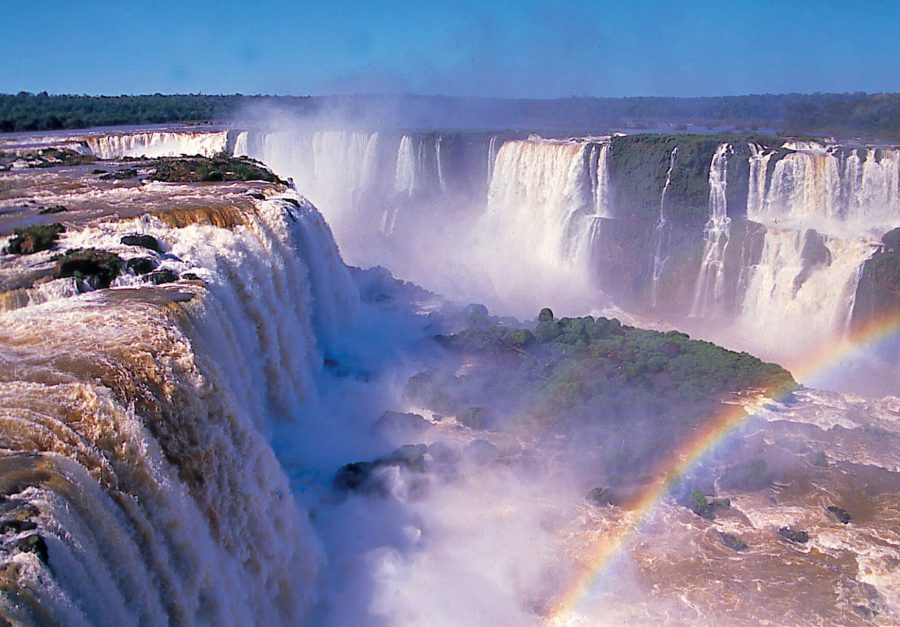
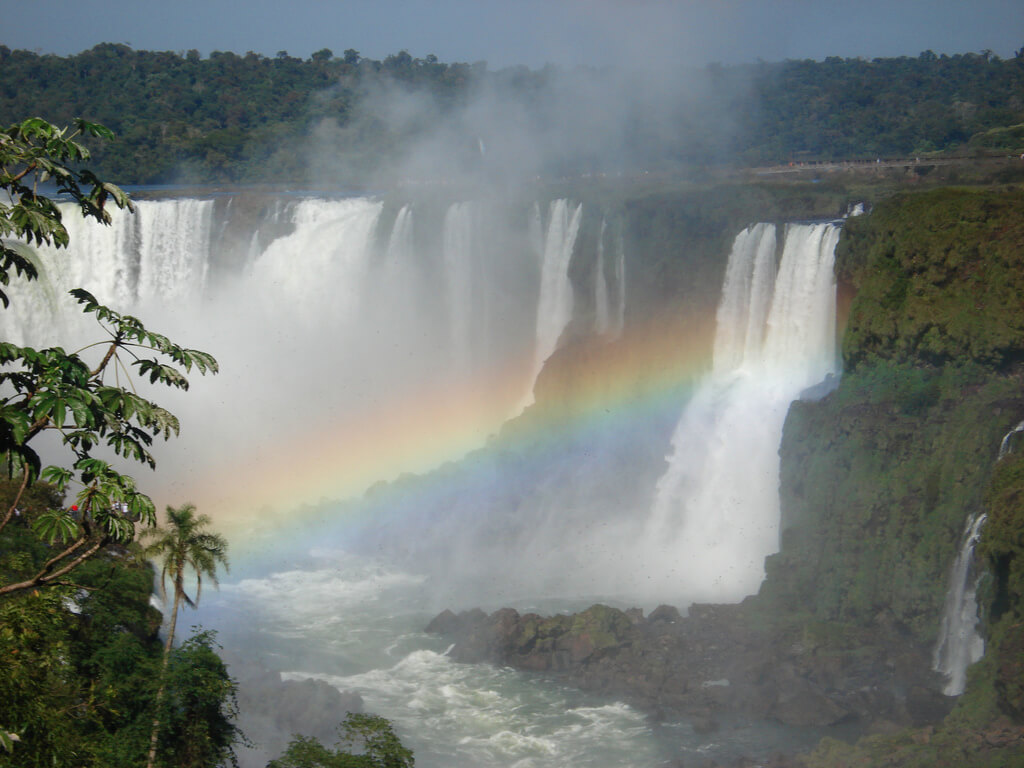
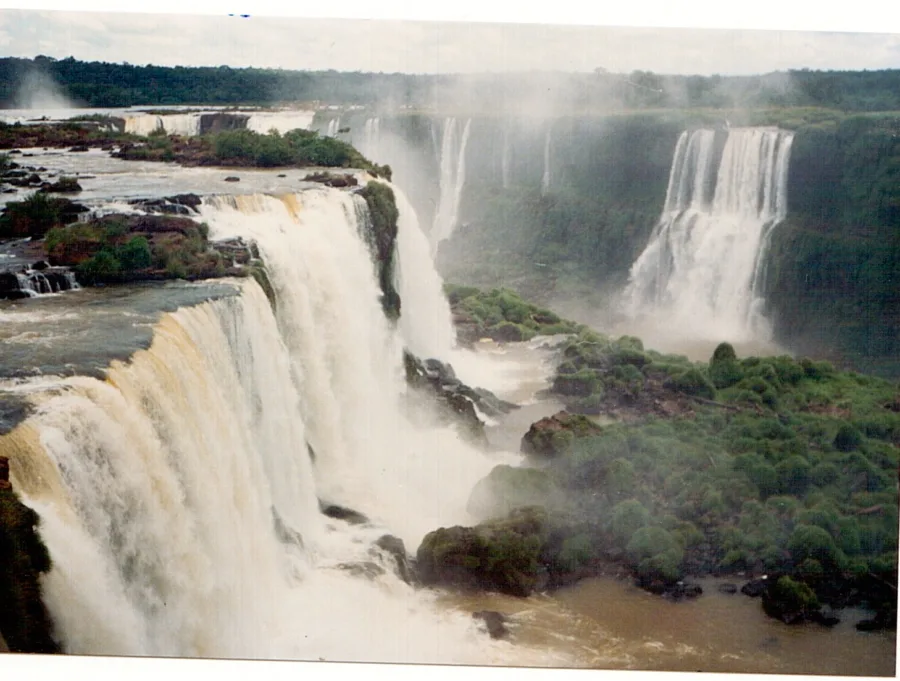
There are 275 individual Iguazú waterfalls scattered along a canyon that runs for nearly three kilometres, at the exact point where three countries meet. The Brazilian city of Foz do Iguaçu sits between the Paraná and the Iguazú, the two rivers that draw the borders, separating it from Ciudad del Este in Paraguay and Puerto Iguazú in Argentina. Locals call this meeting point the Triple Frontier.
The name Iguazú comes from the Guaraní words y, meaning water, and guasú, meaning big. Big water. It could not be more apt.
The park around the falls feels never-ending, one of the last great stretches of continuous Atlantic forest left in the region. Walking the immaculate boardwalks, you step into a fairy-tale world of huge trees and a great variety of orchids, with parrots, toucans and a constant, shimmering traffic of butterflies. The concert of birds plays on over the unbroken roar of the water.
At a glance
- Where: the border of Argentina and Brazil, with Paraguay at the Triple Frontier
- The falls: around 275 cascades over nearly three kilometres, dropping up to 82 metres. About 80 per cent sit on the Argentine side
- Two parks: Iguazú National Park (Argentina, Puerto Iguazú) and Iguaçu National Park (Brazil, Foz do Iguaçu), separate countries and separate tickets
- How long: a full day on the Argentine side, two to three hours on the Brazilian side. Both, ideally
- Documents: a passport to cross the border. Most nationalities need no visa for Argentina, but since April 2025, US, Canadian and Australian citizens need an eVisa for Brazil. See below
- Expect to get wet: the spray is part of the experience, so bring a waterproof case for your phone or camera
The Brazilian side: the panorama
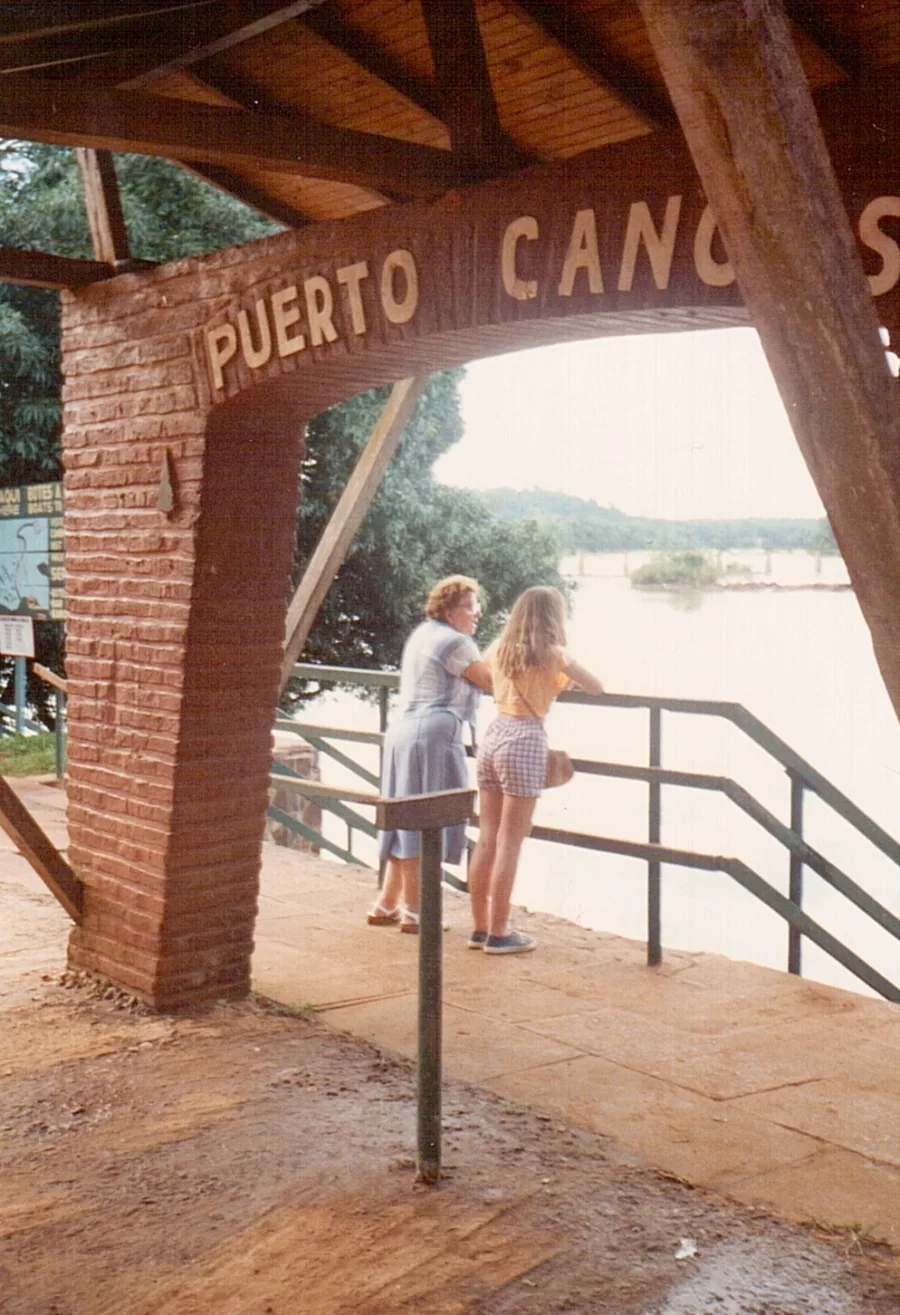
The Brazilian park gives you the wide-angle view, the whole sweep of the falls laid out across the gorge in front of you. The main route is the Trilha das Cataratas, a paved walkway of about 1.4 kilometres along the canyon rim, with the cascades in sight from start to finish and a famous boardwalk that extends towards the spray of the Devil’s Throat, visible from below. A panoramic lift at the end carries you up to the Porto Canoas area, with its restaurants and views. Shuttle buses run from the entrance to the trailhead.
It’s the shorter visit, two to three hours, and the light is best in the morning, with the sun behind you and on the water. For boat lovers, the Macuco Safari runs inflatable boats right under the falls from the Brazilian side, and you will be soaked to the skin. Gloriously so.
The Argentine side: among the falls
The Argentine side is upstream, holds the great majority of the cascades, and is a full day in its own right. Here, you don’t look at the falls so much as walk in amongst them.
A free narrow-gauge train, the Tren Ecológico de la Selva, links the visitor centre to the trailheads. From there, the Upper Circuit carries you along the tops of the falls, the Lower Circuit descends towards their feet, and the pools, and a short free boat hops across to Isla San Martín, the island set right among the cascades. If you want the adrenaline, the Gran Aventura takes you by zodiac beneath the falling water. Allow five to eight hours and don’t rush it.
The Devil’s Throat
Of everything, this is the one you don’t miss. The Garganta del Diablo, the Devil’s Throat, is a vast U-shaped chasm where fourteen waterfalls converge and pour some 82 metres into the gorge, throwing up a permanent cloud of mist you can see for kilometres. On the Brazilian side, you meet it from across the canyon, all scale and distance. On the Argentine side, you stand atop it, at the very edge of a 1.1-kilometre walkway built out over the calm river, until the water simply disappears beneath your feet. The roar makes conversation pointless. It is one of the most astonishing viewpoints I have ever stood at.
One honest, practical note: this walkway is the part most often closed on short notice when the river is at flood level after heavy rain. The rest of the park stays open, but it’s worth checking conditions with the park or your guide the evening before, so the Devil’s Throat doesn’t slip through your fingers.
Crossing the border: passports and visas
The two parks are in different countries, so crossing from one to the other involves crossing an international border. Carry your passport.
The rules have changed in recent years, so this is worth getting right. Most nationalities, including citizens of the EU, the UK, and the United States, do not need a tourist visa for Argentina. Brazil is the one to watch: since 10 April 2025, citizens of the United States, Canada and Australia must obtain an eVisa before travelling, apply online, and it is valid for multiple entries. Citizens of the EU and the UK still do not need a visa to travel to Brazil. As ever, check your own nationality’s current requirements before you book, because these things move.
Around the falls
If you come this far, and you really should, leave time for what surrounds the water.
Plan a visit to Itaipú, one of the world’s largest hydroelectric dams, straddling the Paraná River between Brazil and Paraguay. I remember endless arguments about it at home when I was a child, and they were not misplaced: its reservoir famously drowned the once-mighty Guaíra Falls upstream, and the scale of any failure is hard to imagine. It is a humbling, complicated thing to stand in front of.
Don’t miss the Jesuit missions either, the romantic ruins that dot all three countries, several of them now UNESCO World Heritage sites. And if you like markets, the one in Ciudad del Este, Paraguay, has absolutely everything, at prices that feel like a different planet from Argentina’s. The leather bag I bought there is still beautiful, years on. In Foz do Iguaçu, there is also the striking Omar Ibn Al-Khattab Mosque, among the largest in South America.
A few honest practicals
- Get wet, plan for it. Tropical downpours here are completely routine. The sky swings from too-bright sun to a flood and back in minutes, an umbrella is useless, and you’ll be soaked one moment and dry the next. The humidity and the spray around the falls should never be underestimated, so a waterproof case earns its place.
- Arrive at opening. The first hour is by far the quietest on both sides. On the Argentine side, ride the train straight to the Devil’s Throat first, then work back through the circuits against the crowd.
- Don’t feed the coatis. These raccoon-like creatures look charming and will bite and scratch for food, so keep snacks sealed inside a closed bag.
- For the Brazilian park, a yellow fever vaccination is recommended, so check the latest health advice well before you travel.
- Book ahead in peak season, December to February, especially when entry can sell out a few days in advance.
Iguazú is not a postcard you tick off. It soaks you, deafens you, and sends you home changed. Of all the wonders I have been lucky enough to stand in front of, this is the one I would turn around and go back to tomorrow.
Further reading
- Iguazú National Park, Argentina, the official park site
- Iguaçu National Park, Brazil, the official park site
- Brazil’s official eVisa portal, for US, Canadian and Australian travellers
FAQ
Both sides are worth visiting because they offer different experiences. The Brazilian side gives a wide panoramic view of the whole falls in two to three hours, while the Argentine side holds around 80 per cent of the cascades and lets you walk among them on circuits and out to the Devil’s Throat, easily a full day. If you can, see both.
Two days is ideal: a full day on the Argentine side for the circuits and the Devil’s Throat, and a half-day on the Brazilian side for the panorama. With careful timing and an early start, it can be done in a single long day, but two takes the pressure off and lets you enjoy it.
You always need a passport to cross between Argentina and Brazil. Most nationalities, including EU, UK, and US citizens, do not need a tourist visa for Argentina. For Brazil, since April 2025, US, Canadian and Australian citizens must obtain an eVisa in advance, while EU and UK citizens do not. Always check your nationality’s current rules before booking.
The Devil’s Throat, or Garganta del Diablo, is the largest and most powerful section of Iguazú Falls: a U-shaped chasm where fourteen waterfalls converge and drop about 82 metres. On the Argentine side, an elevated 1.1-kilometre walkway takes you to its very edge, while the Brazilian side offers the wide view from across the canyon.
Iguazú can be visited year-round, with water levels highest from roughly March to May after the summer rains, and the rainforest at its lushest. Visiting the park opening gives you the quietest hour. The Devil’s Throat walkway may close temporarily during high-water conditions, so check conditions the evening before.