

A short editorial note before you read (updated 2026). This is an interview with Roberto, a seasoned independent traveller, about a train journey across India. His trip dates back to 2002, and I first published our conversation in 2019, so read it as a personal account rather than an up-to-the-minute guide. India is straightforward to travel and generally welcoming, but a few regions are sensitive: the security situation in Jammu and Kashmir in particular varies and has seen incidents in recent years, with periodic India-Pakistan tension, so always check your government’s current travel advice for specific areas before you plan. Practical details like visas also change; I have updated those below. Now, over to Roberto.
A while ago, talking about solo travel on Twitter, I met a great traveller, Roberto, and thought at once that I should ask him for an interview. Roberto has always travelled the way I love to: alone, and using only public transport, which since 2008 has been the thread running through all my own trips. When he told me about crossing India by train, I could picture it instantly, and asked him the questions I would have wanted answered myself.

Tell me a little about yourself. What do you do?
My name is Roberto, I am 47, and I live in a small town between Padua and Venice. I have a degree and a PhD in Molecular Biology, and I am the technical manager of a small biomedical research centre within the University of Padua.
What led you to this trip to India?
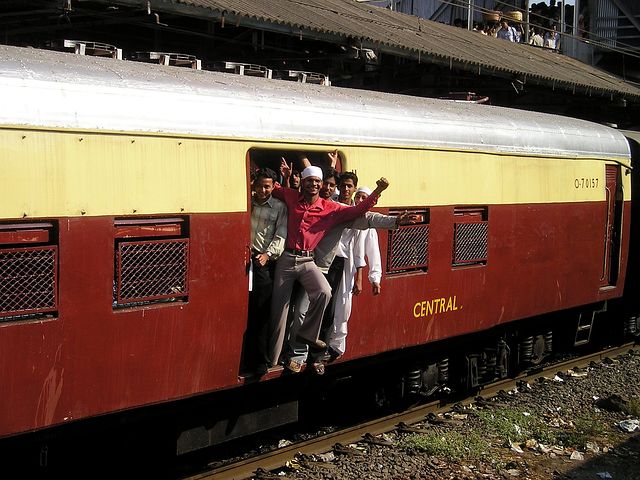
I should say first that this was a trip taken in 2002, when Italians were only just beginning to think of India as an industrial and technological power, and the country was still relatively unknown to us. I had a visceral passion for travel from an early age, and India was one of my dream destinations. And for someone who had already done the European inter-rail many times, the vast Indian rail network was reason enough to go: on the trains, I could reach almost anywhere.
What was your very first impression?
Arriving at Mumbai airport at night. I still remember the lights of that megalopolis as we landed, not orderly, rational lights but a swarm of little flames, as if the city were a living organism. Once through customs, I came straight out beside one of the city’s largest slums, near Vile Parle. Informal settlements are a constant in India, a reminder of the subcontinent’s complexity and its immense problems, but also of the extraordinary vitality of its people: even at three in the morning, along the road beside the shanty town, you could sense a great deal of work going on, people carrying things, trading, cooking.


Could you interact with the locals?
Contacts were happily random. I met and talked with many people on the various trains; in general they were kind, and almost shy towards Westerners. I never had a single security problem. The one place I felt “observed” and out of place was at the Diamond Bazaar in Lahore, but that was across the border in Pakistan, and I would say clearly: check your government’s current advice before contemplating travel there.
What did you like most?
Some real jewels: the Taj Mahal, the cities of Rajasthan, Jaisalmer, and finding, in Goa, a corner that felt almost South American.
And what did you not like?
The extreme, widespread poverty, and the very strong smells of overcrowded places, which one can never quite like. I also think the search for spirituality that draws so many Westerners to India is questionable, though that is an entirely personal opinion.

What is the right approach for a first visit?
When I went in 2002 I was already an experienced independent traveller, and even so it was tough. The right approach is flexibility, patience, and accepting from the outset that you will meet a certain amount of inconvenience.
Which places would you still recommend, years on?
Classic India deserves a visit. But if you want to explore lesser-known areas, I would suggest Assam and Kerala, and Kashmir, though for the latter you must check the current situation and official advice, as access for tourists depends heavily on the security picture at the time.


Anything else you would like to share?
It was a journey of real personal growth, one I would be curious to repeat years later.
Which other trips have you loved?
Last year I was in Iran, and it made a deep impression: a very particular country, where you must adapt to local rules, but whose historic cities feel like the East of the Thousand and One Nights, and whose archaeological sites, Persepolis and Pasargadae, are true wonders of the world.
And your next trip?
Two months ago I was in Argentina; now I am thinking about China.

Travel to India: practical information
India is at once ultra-modern and desperately poor, a paradise of contradictions, and that is exactly why it is a trip to prepare carefully, less for the itinerary than for an understanding of the culture and the reality on the ground.
- Official tourism site: Incredible India.
- Passport and visa: you need a passport valid for at least six months on entry, and a visa. India offers tourist e-Visas of various durations (from short stays up to multi-year options) through the official portal, indianvisaonline.gov.in. Check the current options, validity and fees, and the requirements (such as proof of onward travel), before you book, as they change.
- Money: the currency is the rupee, which cannot be exported or easily obtained outside India; change euros or dollars on arrival, and use cards in hotels and authorised shops in the cities.
- Connectivity: a foreign SIM is expensive and patchy; buy a local SIM (or use a travel eSIM) on arrival.
- Time: India runs on a single time zone, UTC+5:30, all year, so it is 4 hours 30 minutes ahead of Italy in winter and 3 hours 30 minutes ahead when Italy is on summer time.
- Language: you will manage easily with English. India has more than twenty official languages and hundreds of others, so Hindi alone will not take you everywhere.
Safety and health
As in any densely populated country with widespread poverty, petty crime is a factor almost everywhere, as are stomach upsets from hygiene. For both, the right sources are your government’s official travel advice and a travel-health clinic before you go, rather than a blog. Plan vaccinations and any prophylaxis with a doctor in good time.
Have a wonderful, and safe, trip to India.
Frequently asked questions
Yes. India has one of the largest rail networks in the world, reaching almost everywhere, and train travel is a classic, affordable and deeply atmospheric way to see the country, from short hops to epic overnight journeys. Book ahead where you can, choose your class to suit your comfort level, and allow for delays with patience and flexibility.
Yes. Most visitors need a passport valid for at least six months and a visa; India offers tourist e-Visas of various durations through the official portal (indianvisaonline.gov.in). Check the current options, validity and fees, and any requirements such as proof of onward travel, well before you travel, as the rules change.
India is a rewarding but demanding destination that many independent and solo travellers love. Take normal big-city precautions against petty crime, be cautious with food and water hygiene, and research cultural norms, especially for women. Some regions, notably Jammu and Kashmir and border areas, are sensitive, so always check your government’s current travel advice for specific areas.
Broadly, the cooler, drier months from around October to March are the most comfortable for much of India, avoiding the intense pre-monsoon heat and the summer monsoon rains. The ideal timing varies by region, however, from the deserts of Rajasthan to the Himalaya to the tropical south, so plan around where you are going.
Further reading
- More traveller interviews: a hiking trip to Nepal and travelling in Iran and Afghanistan
- Planning wider Asia travel: my tips for travelling in Southeast Asia
- Always check official travel advice, for example the UK FCDO’s India page