


Some places you love because you discovered them; others you love because they are woven into who you are. Porto Venere is the second kind for me. It stands at the western tip of the Gulf of Poets, my own gulf, and it is where my parents fell in love, so I have never been able to see it with a stranger’s eyes, and I would not want to.
It is also, quite simply, one of the most beautiful places in Liguria, and, together with the Cinque Terre and the islands of Palmaria, Tino and Tinetto, a UNESCO World Heritage Site since 1997. Here is how to see it.
A port named for Venus
The Romans knew it as Portus Veneris, the port of Venus, and built a temple to the goddess on the rocky promontory that closes the village to the sea. It is a fitting origin: even now there is something of the myth about the place, the pastel tower-houses rising straight from the water, the black rock, the light. Over the centuries it became a Byzantine and then a Genoese naval stronghold, guarding the mouth of the gulf, and much of what you see, the castle, the church on the point, the wall of houses, is Genoa’s work.


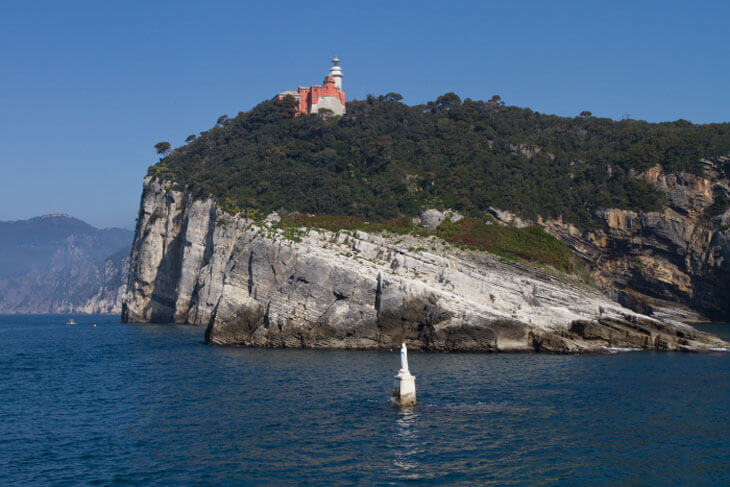
The church of San Pietro
Where the temple of Venus once stood, on the very tip of the promontory, rises the church of San Pietro, and it is the image of Porto Venere everyone carries away: a striking striped church in the black-and-white Genoese Gothic style of the thirteenth century, built on the remains of a much older early-Christian church. Walk out to it, step onto its loggia over the sea, and you understand why poets lost their heads here. On a windy day the waves crash below and the whole horizon is water and sky.
Byron’s Grotto and the poets
Just below the church, the sea has carved a dramatic cove once called the Grotta Arpaia and now known as Byron’s Grotto. Lord Byron loved this gulf, and legend has it he swam from here right across the bay to Lerici, to visit his friend Shelley, who was living at San Terenzo, and who drowned in these same waters in 1822. It was that circle of Romantics, Byron and Shelley, and later George Sand and Alfred de Musset, and all the writers who followed, that eventually earned the bay its name, the Gulf of Poets. Stand at the grotto and it is not hard to see what they saw.
The castle and the village
Above the village broods the Castello Doria, the great Genoese fortress, well worth the climb for the views back over the rooftops, the church on its point, and the islands. Coming down, lose yourself in the carruggi, the narrow Ligurian lanes, above all Via Capellini, threaded through the tall houses, and do stop for a slice of warm focaccia, which here, as everywhere in Liguria, is a small daily miracle.
The famous seafront, the palazzata, is that colourful, improbably tall row of tower-houses standing shoulder to shoulder along the water, built centuries ago to double as a defensive wall. It is the first thing you see arriving by boat, and the last you look back at as you leave.
The Madonna Bianca
Up in the old village stands the Romanesque church of San Lorenzo, which guards Porto Venere’s most beloved treasure: the icon of the Madonna Bianca, the White Madonna, the village’s patron. Once a year, on the evening of 17 August, the village celebrates her with one of the most moving festivals on this coast: the lights are switched off and Porto Venere is lit instead by thousands of candles and torches, set along the seafront, the walls and the cliffs, until the whole promontory glows. If you can time a visit to it, do; it is unforgettable. (Do check the current arrangements for the festival before planning around it.)

The three islands
Facing the village lie the three islands that share its UNESCO listing. Palmaria, the largest island in Liguria, is a short hop across the strait and rewards a walk and a swim (and a meal). Tino, a military island, opens to the public only around 13 September, for the feast of its patron San Venerio. And little Tinetto is a bare rock crowned by the ruins of an ancient oratory. Seen together from the water, from a boat or the ferry, they are the perfect full stop to the gulf.
How to get there
Porto Venere is not on the railway, which is part of its charm. Come by road or bus from La Spezia (about half an hour), or, far better, by sea: ferries run from La Spezia, from Lerici across the gulf, and, in season, from the Cinque Terre. Arriving by water, with the palazzata and the church of San Pietro rising ahead of you, is the way to first meet Porto Venere, and, as I always say of my region, Liguria is made to be seen from the sea. Check current ferry timetables before you go, as they change with the season.
Come out of the high summer if you can, when the village breathes and the light does its quiet work, and give yourself an evening here. Watch the sun go down behind Palmaria from the steps of San Pietro, and you will understand why some of us never quite manage to see this place as anything other than home.
Frequently asked questions
Porto Venere (Portovenere) sits at the western tip of the Gulf of La Spezia, the “Gulf of Poets”, in eastern Liguria. It is not served by train: you reach it by road or bus from La Spezia (about 30 minutes), or, more beautifully, by ferry from La Spezia, from Lerici across the gulf, or, seasonally, from the Cinque Terre. Check current ferry timetables, which vary by season.
The essentials are the striped Gothic church of San Pietro on the sea-lashed promontory (where a temple to Venus once stood), Byron’s Grotto below it, the Doria castle above the village, the Romanesque church of San Lorenzo with its Madonna Bianca icon, the colourful seafront row of tower-houses (the palazzata) and the carruggi behind it. Facing the village are the islands of Palmaria, Tino and Tinetto.
Porto Venere, together with the Cinque Terre and the three islands of Palmaria, Tino and Tinetto, was inscribed on the UNESCO World Heritage list in 1997, recognised as an exceptional cultural landscape shaped by centuries of human life on a dramatic and difficult stretch of coast. Porto Venere’s Genoese architecture, church of San Pietro and island setting are central to that listing.
It is Porto Venere’s patronal festival, held on 17 August in honour of the Madonna Bianca (the White Madonna), whose icon is kept in the church of San Lorenzo. On the evening of the festival the village lights are switched off and Porto Venere is illuminated instead by thousands of candles and torches along the seafront, walls and cliffs, a spectacular and moving sight. Confirm the current arrangements before planning a visit around it.
Yes. The Gulf of La Spezia is known as the Gulf of Poets thanks to the Romantics who loved it: Lord Byron, who by legend swam across the bay from the Porto Venere grotto that now bears his name to visit Shelley, and Percy Bysshe Shelley, who drowned in these waters in 1822, along with George Sand, Alfred de Musset and many writers since.
Further reading
- The whole gulf, from the water: sailing the Gulf of Poets
- Across the promontory: San Fruttuoso, the abbey in a hidden cove and a day trip to Portofino
- My home region, coast to coast: the Cinque Terre and Liguria